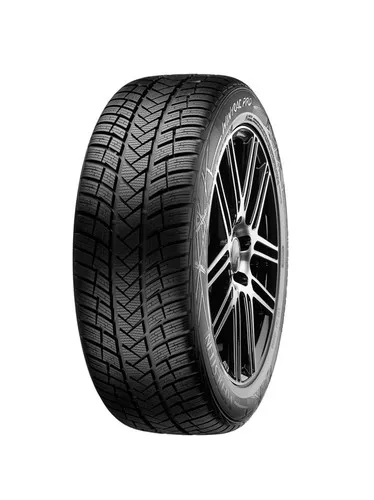
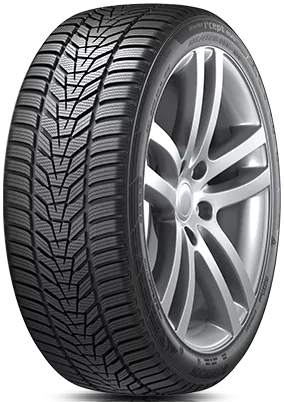
Hankook wins on wet safety and snow; Vredestein counters with quieter ride and sharper dry handling.
On paper, the Hankook Winter i*cept evo3 W330 and the Vredestein Wintrac Pro occupy similar ground — both are R17–R22 winter tyres aimed at premium and upper-middle buyers who want serious cold-weather capability. In practice, they are built around different priorities, and twelve shared tests tell the story clearly: Hankook wins eleven of them. That does not make the Vredestein a poor tyre — it remains competent on wet and dry roads and earns genuine owner loyalty, particularly on performance cars — but the evo3 is the more rounded, more current product, while the Wintrac Pro is now in the process of being superseded by the Vredestein Wintrac Pro+. Understanding what each does well tells you whether the gap matters for how you actually drive.
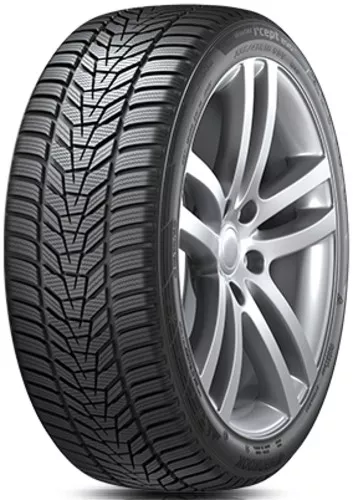
Winter i*cept evo3 W330
Wintrac Pro


Averaged from 9 tests
Hankook Winter i*cept evo3 W330
Vredestein Wintrac Pro
Hankook Winter i*cept evo3 W330
Vredestein Wintrac Pro
Hankook Winter i*cept evo3 W330
Vredestein Wintrac Pro
Hankook Winter i*cept evo3 W330
Vredestein Wintrac Pro
Hankook Winter i*cept evo3 W330
Vredestein Wintrac ProWet performance is where the Hankook evo3 asserts itself most convincingly. Across two measured braking tests, it averages 33.8m in wet braking against the Vredestein's 34.8m — a consistent 1m advantage that multiple test seasons have confirmed. Aquaplaning resistance is an even sharper differentiator: the evo3 builds on Hankook's Winter Control Compound and wider lateral grooves specifically to handle standing water, and the results show it. The Vredestein manages wet roads competently and its cornering aquaplaning has been praised in several tests, but its overall aquaplaning resistance consistently trails the Korean tyre. On wet handling circuits, the evo3 shows a tendency toward mild understeer which keeps it predictable and safe, while the Vredestein's wet handling balance has drawn more mixed feedback — serviceable rather than confidence-inspiring. For drivers in consistently damp climates, the evo3's wet safety package is the more complete one.
Hankook Winter i*cept evo3 W330
Vredestein Wintrac Pro
Hankook Winter i*cept evo3 W330
Vredestein Wintrac Pro
Hankook Winter i*cept evo3 W330
Vredestein Wintrac Pro
Hankook Winter i*cept evo3 W330
Vredestein Wintrac ProDry performance is the one area where the Vredestein holds a measurable structural advantage. Its dry braking score substantially outpaces the Hankook's, and testers have consistently praised its stable lateral grip, precise handling, and composed limit behaviour on dry asphalt — qualities that make it particularly appealing to drivers of powerful rear-wheel-drive cars. The Hankook evo3 is not weak on dry roads — ADAC praised its safe and precise dry-road behaviour in 2025 — but its dry braking lags noticeably, and several testers flagged sluggish steering response and reduced dry braking reserves when pushed. If dry handling confidence on a performance car is your primary winter concern, the Vredestein's dry dynamic character is its strongest card. The Hankook counters with more composed and consistent behaviour across the full dry-to-wet spectrum, even if it is not the sharper instrument on a dry circuit.
Hankook Winter i*cept evo3 W330
Vredestein Wintrac Pro
Hankook Winter i*cept evo3 W330
Vredestein Wintrac Pro
Hankook Winter i*cept evo3 W330
Vredestein Wintrac Pro
Hankook Winter i*cept evo3 W330
Vredestein Wintrac ProSnow braking is essentially a dead heat across the measured data: the evo3 averages 27.7m and the Wintrac Pro 27.8m across two comparable tests — a gap too small to matter in practice. The character difference emerges in snow handling rather than raw stopping power. Hankook developed the evo3 at its Technotrac facility in Ivalo, Finland, and the tyre's gull-wing grooves and High 3-Grip sipes deliver strong snow traction and handling balance — Sportauto highlighted its excellent snow balance and full grip reserves as particularly well-suited to powerful BMW applications. The Vredestein holds up on snow for a tyre of its age, with solid traction and acceptable handling balance praised across 2023 and 2024 tests, though its lateral reserves on packed snow have been flagged as limited. In deep or frequent snow, the Hankook is the safer choice; in light or occasional winter conditions, both perform adequately.
Hankook Winter i*cept evo3 W330
Vredestein Wintrac Pro
Hankook Winter i*cept evo3 W330
Vredestein Wintrac ProNoise is the Hankook evo3's most consistent weakness, and buyers should factor it in. Multiple test seasons have flagged elevated rolling noise — ADAC 2025 specifically called it out, and Sportauto noted comfort shortcomings alongside audible rolling noise at speed. The Vredestein is measurably quieter and offers a more refined long-distance character; owner reviews on TyreReviews (88/100 average across 30 ratings) reflect this, with drivers of high-powered cars like the BMW M240i and Audi S5 describing the ride quality positively. Mileage is a further point in the Vredestein's favour — its projected tread life score is nearly double the Hankook's, which has drawn criticism across multiple seasons for wear rates. The evo3 recovers somewhat on rolling resistance, where it holds a meaningful efficiency advantage over the Vredestein — relevant for drivers covering high motorway mileage in fuel-cost terms, even if tread life itself is a concern.
Hankook Winter i*cept evo3 W330
Vredestein Wintrac Pro
Hankook Winter i*cept evo3 W330
Vredestein Wintrac ProThe Hankook Winter i*cept evo3 W330 is the more accomplished all-round winter tyre of the two. Its eleven wins from twelve shared tests are not a statistical quirk — they reflect genuinely better wet braking, stronger aquaplaning protection, and superior snow handling capability that matters in real European winters. Drivers who regularly encounter standing water, slush, or unpredictable winter conditions should choose it without hesitation, accepting the noise penalty as the price of that safety margin. The Vredestein Wintrac Pro makes most sense for performance car drivers who spend their winters on mostly dry or lightly damp roads and value the crisper dry handling balance and quieter cabin — owner reviews suggest it earns real loyalty in exactly that use case. Be aware, however, that the Wintrac Pro is being replaced by the Wintrac Pro+; buyers considering it should check whether updated stock is available before committing. For most drivers, the evo3 is the straightforward recommendation.
| Organization | Season | Year | Dimension | |
|---|---|---|---|---|
Autobild | Winter | 2020 | 225/40 R18 | View |
Autobild | Winter | 2023 | 225/40 R18 | View |
Sportauto | Winter | 2023 | 225/40 R18 | View |
Autobild | Winter | 2021 | 225/45 R18 | View |
Autobild | Winter | 2023 | 225/45 R18 | View |
AUTOBILD | Winter | 2024 | 235/35 R19 | View |
Autobild | Winter | 2022 | 245/40 R19 | View |
Autobild | Winter | 2020 | 245/45 R18 | View |
AUTOBILD | Winter | 2024 | 245/45 R18 | View |
Compare prices across all available dimensions for these tyres.
VS
VS
VS
VS
VS
VS
VS
VS
VS
VS
Hankook Winter i*cept evo3 W330 vs Michelin Pilot Alpin 5
Hankook Winter i*cept evo3 W330 vs Bridgestone Blizzak LM-005
Hankook Winter i*cept evo3 W330 vs Continental WinterContact TS 870 P
Vredestein Wintrac Pro vs Bridgestone Blizzak LM-005
Vredestein Wintrac Pro vs Continental WinterContact TS 870 P
Vredestein Wintrac Pro vs GoodYear UltraGrip Performance+
Vredestein Wintrac Pro vs Michelin Alpin 6