The Continental AllSeasonContact 2 emerges from its test results as one of the most consistently well-rounded all-season tyres in the category, with a character defined by composure and balance rather than any single outstanding peak — but it carries one persistent, clearly documented weakness that runs through almost every evaluation.
That weakness is aquaplaning resistance, and it is essentially universal across the test data. Every organisation that measured it — AutoBild across multiple size variants, AutoExpress, Aftonbladet, and TyreReviews — flagged aquaplaning performance as the tyre's clearest shortfall, whether in curved or straight-line scenarios. The Aftonbladet test went furthest, stating the tyre aquaplanes easily and describing the feeling as uncomfortable, while AutoExpress placed it last in both deep-water tests. This is not a size-dependent or situational finding; it represents a structural characteristic of the tyre's design that buyers should weigh carefully if they regularly encounter standing water at speed.
Everywhere else on wet roads, however, the story reverses entirely. Wet handling and wet braking are among the tyre's most celebrated attributes. TyreReviews rated it best in wet handling overall, AutoExpress recorded the quickest time around a wet handling circuit and praised its blend of low-speed agility with high-speed composure, and multiple AutoBild evaluations highlighted short wet braking distances and sporting behaviour on wet tarmac. Even Aftonbladet — despite its criticism of aquaplaning — acknowledged that the tyre posted the shortest braking distance of all tested tyres on cold, wet asphalt. The conclusion is that the AllSeasonContact 2 is highly capable on wet roads in controlled conditions, but loses ground specifically when surface water accumulates.
Winter and snow performance is another consistent strength. ADAC awarded it the only 'good' overall rating in its test group, explicitly praising balanced safety across all seasons. AutoBild in two separate size tests described convincing winter qualities, strong snow and ice grip and short snow braking distances. TyreReviews went further, rating it best in snow traction and best overall on ice — a remarkable result for an all-season product. AutoExpress similarly recorded the best snow braking result in its field and described confident, reassuring behaviour through faster winter handling sections, though noting a slight nose-led tendency that affected precision at lower speeds.
Dry performance is where the picture becomes more nuanced. AutoBild in several formats and TyreReviews both praised dry handling — described as direct, dynamic and offering good safety reserves — and the tyre's behaviour in faster dry corners is generally described as composed and confidence-inspiring. However, dry braking divides opinion between tests: where AutoBild and ADAC found adequate to good results, both Aftonbladet and TyreReviews identified extended dry braking distances as a notable limitation. Aftonbladet was particularly critical, describing long braking distances at all temperatures, a diffuse feel and slow steering response — a verdict that stands in stark contrast to the more flattering handling impressions recorded elsewhere. A tendency toward understeer is mentioned in some AutoBild tests, echoed by AutoExpress's observation of a nose-led balance, suggesting this is a genuine if manageable characteristic rather than an isolated finding.
Rolling resistance and noise are consistent positives. Multiple evaluations noted low rolling resistance contributing to real-world fuel savings, and pass-by noise levels were rated well in AutoBild testing. AutoExpress described the tyre as refined over various surfaces, though noted it could feel slightly rough when pressed hard in dry conditions.
On mileage and value, the results are mixed. ADAC noted lower mileage than the best environmental performers, and one AutoBild test flagged slightly limited kilometre output. TyreReviews, however, recorded the lowest wear of any tyre in its test group and named the AllSeasonContact 2 the best value per thousand kilometres — a reminder that initial price and long-term cost can point in very different directions. The tyre's list price is frequently described as high or the highest in its test group, which makes the wear efficiency argument important for buyers considering the full cost of ownership.
These tyres were not tested together in the same test. The scores below are aggregated from different independent tests, so direct comparison should be taken with caution.
Dimensions and prices
Compare prices across all available dimensions for these tyres.


 VS
VS
 VS
VS
 VS
VS
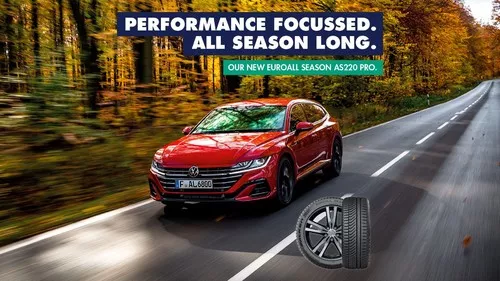
 Falken EuroALL Season AS220 Pro vs Toyo Celsius AS2
 Falken EuroALL Season AS220 Pro vs Kleber Quadraxer 3