Falken favours dry handling and wet braking; Kleber counters with stronger snow performance, comfort and value.
The Falken EuroALL Season AS220 Pro and Kleber Quadraxer 3 approach year-round driving with different priorities. The Japanese Falken offers 51 sizes across 17–21-inch wheels, with V and W speed ratings: a range suited to larger wheels and faster cars. Its supplied product summary emphasises wet and light-snow capability. Michelin-owned French brand Kleber positions the Quadraxer 3 in the upper-middle segment, while the editorial assessment highlights its appeal as an affordable alternative to premium all-season tyres.
The defining difference is Falken's stronger dry handling and wet stopping versus Kleber's winter competence and comfort. Both have compromises that matter more than their overall ratings of 69/100 and 82/100 suggest. Their listed predecessors are the Falken EuroALL Season AS210A and Kleber Quadraxer 2, but no predecessor comparison measurements establish how much either has improved. Nor is usable manufacturer marketing supplied: Kleber's official-description field contains an error page, so it cannot substantiate design claims.
EuroALL Season AS220 Pro
Quadraxer 3


Falken EuroALL Season AS220 Pro
Kleber Quadraxer 3
Falken EuroALL Season AS220 Pro
Kleber Quadraxer 3
Falken EuroALL Season AS220 Pro
Kleber Quadraxer 3
Falken EuroALL Season AS220 Pro
Kleber Quadraxer 3
Falken EuroALL Season AS220 Pro
Kleber Quadraxer 3Average wet braking is 46.0m for Falken versus 48.5m for Kleber across one supplied measured test per tyre. Again, this is a single-result average rather than a broad multi-test estimate. Falken's 2.5m advantage reduces stopping distance by approximately 5.2% relative to Kleber, roughly half a typical car length. Its wet-braking score of 82 against 68.2 supports that result, while repeated criticism of Kleber's extended wet stops makes this a consistent concern rather than an isolated numerical weakness.
Standing water reverses the preference. Kleber's aquaplaning score is 78.8 versus Falken's 67.5, backed by repeated praise for its reserves; Falken attracts criticism for only moderate resistance. Water clearance and grip on wet asphalt are different capabilities, which explains why Kleber can resist aquaplaning better yet brake worse. Neither is an especially incisive wet-cornering choice: both receive understeer criticism, and Kleber adds weak feedback and slow responses. Falken's wet-handling detail score of 65 also limits its sporting credentials in rain. For the driver, Falken offers the stronger measured emergency stop, while Kleber offers more reassurance against water-induced loss of contact; neither advantage cancels the other weakness.
Falken EuroALL Season AS220 Pro
Kleber Quadraxer 3
Falken EuroALL Season AS220 Pro
Kleber Quadraxer 3Average dry braking is 39.8m for Falken versus 38.3m for Kleber across one supplied measured test per tyre. The dataset contains no separate aggregate braking field; these averages therefore represent only the shared 225/45 R17 braking comparison. Kleber stops 1.5m shorter, approximately 3.8% less distance than Falken. That is a meaningful margin when space is tight, although less than a typical car length. The starting speed is unspecified, so these should not be presented as confirmed 100km/h stopping distances.
Braking does not tell the whole dry-road story. Falken earns repeated praise for dynamic handling, supported by an 87.5 dry-handling detail score and a 79.3 overall dry score against Kleber's 60.1. Kleber's stronger braking score, 81.4 versus 71, sits alongside reports of understeer and slow responses. The distinction is between stopping grip and cornering behaviour: Falken appears more rewarding once loaded into a bend, though delayed steering response means it is not razor-sharp on initial turn-in. Owners reinforce that nuance, reporting confident motorway road holding but also some deadness around straight ahead. There are no dedicated high-speed stability measurements or construction details to explain the difference more precisely.
Falken EuroALL Season AS220 Pro
Kleber Quadraxer 3
Falken EuroALL Season AS220 Pro
Kleber Quadraxer 3
Falken EuroALL Season AS220 Pro
Kleber Quadraxer 3
Falken EuroALL Season AS220 Pro
Kleber Quadraxer 3No snow braking distances in metres are supplied, but Kleber has the much stronger overall winter evidence. Its snow score is 81 against Falken's 54, with snow-braking detail scores of 86.1 versus 59.5 and traction scores of 83.7 versus 64. These are scores, not stopping distances or percentage grip differences. Kleber also records 85.9 for snow handling and 86.5 for snow-circle cornering, supporting a rounded ability to accelerate, turn and stop rather than a narrow advantage in one exercise.
Falken is not uniformly poor on snow: one test praises traction and short stops, and a C5 Aircross owner reports a steep snowy climb without wheelspin. However, other feedback identifies snow understeer and merely satisfactory snow-and-ice behaviour. Kleber attracts repeated praise for winter control, including a winter-tyre-level assessment in one test, making it the more convincing choice for recurring snowy journeys. That does not establish equivalence to dedicated winter tyres in every condition. Ice measurements, packed-snow-specific results and explicit 3PMSF certification details are absent, so severe-weather certification cannot be confirmed from this dataset.
Falken EuroALL Season AS220 Pro
Kleber Quadraxer 3Kleber is the better-supported comfort choice, scoring 88.6 overall against Falken's 71.5 and 84.5 versus 65 in the comfort detail scores. Its noise score also leads, 82.2 to 78, and one test records joint-lowest exterior noise. Exterior noise is not cabin refinement, but owners frequently mention quietness, helping connect the measurements to everyday experience. Satisfaction is stronger too: 86/100 from 27 reviews versus Falken's 65/100 from four, plus 9.2/10 from 37 Kleber customer ratings. Those unequal samples provide context rather than a controlled comparison.
There are exceptions worth hearing. One Kleber owner reports pronounced roaring around 135km/h, while Falken owners describe quiet, comfortable running and good coping with potholes. Another finds little cabin-noise change after switching from summer tyres. The evidence favours Kleber for relaxed everyday travel, but does not guarantee quieter cruising in every car or size. Likewise, Falken's softer initial steering feel should not be mistaken for proof of superior bump absorption: its comfort results trail despite that less immediate response.
Running costs also favour Kleber directionally. Rolling-resistance scores are 79.6 versus 51, and mileage scores 63.6 versus 51; Falken additionally receives explicit criticism for elevated resistance and moderate longevity. Kleber still attracts resistance criticism in some tests, so it is not an unqualified efficiency leader. No physical resistance measurements, verified tread-life totals, comparable prices or EU wet-grip and fuel-label grades are supplied. Owner reports at 8,000–10,000 miles do not establish eventual lifespan. Nevertheless, affordable-price feedback, stronger mileage scoring and better resistance scoring give Kleber the more credible lifetime-value case, without supporting a precise saving.
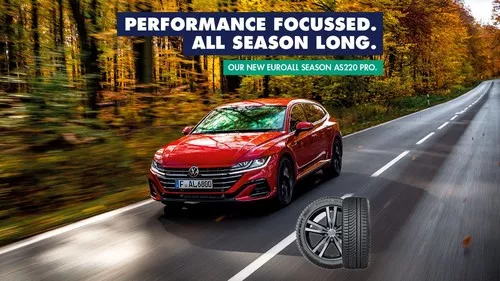
Falken EuroALL Season AS220 Pro
Kleber Quadraxer 3
Falken EuroALL Season AS220 Pro
Kleber Quadraxer 3Choose the Kleber Quadraxer 3 for the more rounded family-car brief: comfortable daily travel, recurring winter weather and value over outright handling enthusiasm. Its shorter measured dry stops and stronger aquaplaning evidence add substance beyond its snow advantage. The shared full assessment placed it seventh of 16 against Falken's sixteenth, even though Falken finished ahead in the braking-only comparison. That distinction explains why strong stopping results alone do not settle an all-season purchase. Kleber's central compromise remains wet asphalt: longer braking and less communicative cornering deserve serious weight in a predominantly rainy climate.
Choose Falken for milder winters when dry-road handling and wet emergency braking take priority, particularly if its 17–21-inch range suits your car. It delivers the more engaging dry-cornering character here, but its steering delay, moderate aquaplaning reserves and weaker cost indicators prevent a clean sporting victory. For most drivers choosing between these two, Kleber earns the recommendation through comfort, winter control and the stronger value evidence. For someone who rarely encounters snow and ranks wet stopping above those benefits, Falken is the defensible alternative—with the clear understanding that stronger wet braking does not mean stronger performance in every rainy-road situation.
| Organization | Season | Year | Dimension | |
|---|---|---|---|---|
Autobild | All season | 2023 | 225/45 R17 | View |
Compare prices across all available dimensions for these tyres.
VS
VS
VS
VS
VS
VS
VS
VS
VS
VS
Falken EuroALL Season AS220 Pro vs Toyo Celsius AS2
Falken EuroALL Season AS220 Pro vs Michelin CrossClimate 2
Falken EuroALL Season AS220 Pro vs Bridgestone Turanza All Season 6
Kleber Quadraxer 3 vs BFGoodrich Advantage All Season
Kleber Quadraxer 3 vs Avon ZV7
Kleber Quadraxer 3 vs Nexen N blue HD Plus