Comparison: Vredestein ULTRAC vs. Continental PremiumContact 7 (2026)
Also compare with
ULTRAC cushions and quietens; PremiumContact 7 stops sooner, steers sharper and lasts longer.
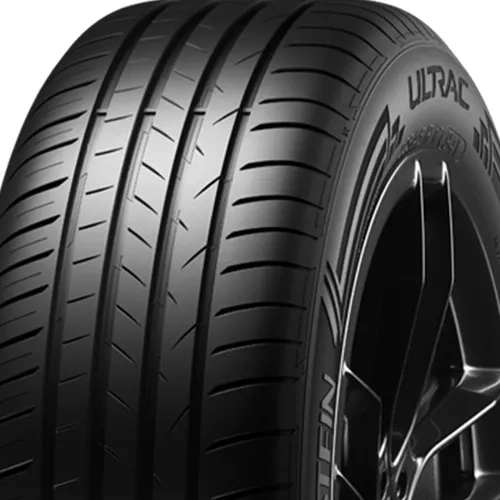
The Vredestein ULTRAC is a premium summer tyre spanning 66 sizes from R15 to R21, so it reaches from ordinary family hatchbacks to large, powerful cars. Made in Hungary, it represents the comfort-led side of the Dutch Vredestein range. Its strongest themes are refinement, predictable wet-road behaviour and sensible pricing rather than uncompromising sporting precision. Although the supplied official description is unusable, the independent evidence consistently portrays a quiet, accommodating road tyre with good braking and aquaplaning reserves.
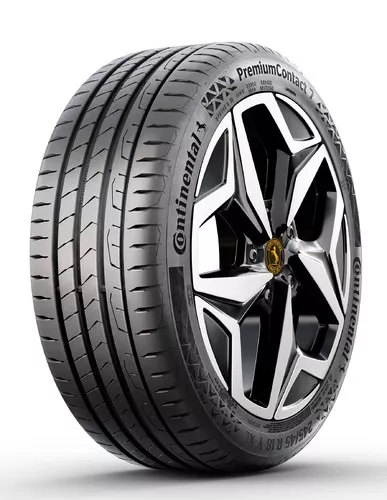
The Continental PremiumContact 7 is the German brand's premium safety-focused all-rounder, offered here in 51 sizes from R16 to R21 and produced across France, Slovakia, Germany and the Czech Republic. It replaced the Continental PremiumContact 6, adding RedChili compound technology intended to deliver grip without a warm-up phase and an adaptive pattern designed for consistent wet and dry handling. Continental targets saloons, family cars, hot hatchbacks and EVs, while selected versions can also incorporate ContiSeal puncture-sealing technology.
The defining difference is control versus cushioning. The Continental feels more immediate, neutral and secure at the limit; the Vredestein generally feels softer, quieter and more relaxed, but can become understeery or unsettled during abrupt direction changes. That distinction is reflected dramatically in the results: PremiumContact 7 defeated ULTRAC in all 11 shared tests, despite the Vredestein occasionally finishing close to it.
 ULTRAC
 PremiumContact 7


These tyres were not tested together in the same test. The scores below are aggregated from different independent tests, so direct comparison should be taken with caution.
 Continental PremiumContact 7Vredestein ULTRACContinental PremiumContact 7Vredestein ULTRACContinental PremiumContact 7Vredestein ULTRACContinental PremiumContact 7Vredestein ULTRACContinental PremiumContact 7Vredestein ULTRACContinental PremiumContact 7Vredestein ULTRACContinental PremiumContact 7
Across the one shared test containing measured dry-braking distances, the Continental averages 35.4 metres against 36.1 metres for the Vredestein. The 0.7-metre difference is modest, but meaningful: in an emergency the Continental has already stopped while the ULTRAC still has roughly the length of a large stride left to travel. Their dry-braking scores are correspondingly close at 86.4 and 85.2, showing that outright stopping ability is not the Vredestein's central weakness.
The larger separation appears when the car is asked to combine grip, steering and rapid weight transfer. PremiumContact 7 records 99 for objective dry handling, 92.3 for steering reaction and 87.8 for measured dry handling. Test feedback repeatedly describes precise turn-in, high reserves and a neutral balance. Its adaptive pattern and compound appear to keep the contact patch working consistently as lateral load rises, so the driver receives a prompt response and can place the car accurately without waiting for the tyre carcass to settle.
ULTRAC still earns a healthy 80.5 overall dry score, 91 for dry safety and 84 for lane changes. It offers ample everyday grip and forgiving handling, and its dry-road adhesion was explicitly praised. The compromise is its softer-feeling structure: testers encountered slower rear response, bouncy behaviour, mild understeer and sensitivity to lift-off weight transfer, including a slightly unstable rear during fast lane changes. An owner of a Civic Type R likewise complained about weak sidewall support and little feel, whereas a Ceed owner valued the same compliance. It is therefore comfortable and approachable at normal speeds, but less coherent when a powerful car is driven hard. Poor grip on cool roads is another warning; Continental's warm-up-independent RedChili concept better suits chilly spring mornings.
Continental PremiumContact 7Vredestein ULTRACContinental PremiumContact 7Vredestein ULTRACContinental PremiumContact 7Vredestein ULTRACContinental PremiumContact 7Vredestein ULTRACContinental PremiumContact 7Vredestein ULTRACContinental PremiumContact 7Vredestein ULTRACContinental PremiumContact 7Vredestein ULTRACContinental PremiumContact 7Vredestein ULTRACContinental PremiumContact 7Across the single shared test with measured wet braking, PremiumContact 7 averages 25.8 metres and ULTRAC 26.6 metres. The Continental's 0.8-metre advantage is larger than the dry gap and aligns with wet-braking scores of 88.4 versus 80. In practical terms, that extra distance can determine whether a sudden stop ends with clearance or contact. Continental's EU wet-grip classification is A across the supplied fitments, reinforcing that braking performance is a core strength rather than one favourable result.
The Continental also dominates wet handling: its objective score is 98.3, measured score 94 and wet-circle score 88.5. It produced a best wet-handling time of 67.70 seconds in one later test and was repeatedly characterised as fast, neutral and predictable. Owners echo this, including one who found the wet grip almost dry-road-like. RedChili compound technology is designed to work immediately, while the adaptive tread manages changing loads and conditions; the result is a tyre that lets the driver brake, turn and correct confidently instead of merely resisting a straight-line skid.
ULTRAC's wet character is nevertheless convincing. It scores 84.5 overall, 89.2 for wet handling, 92.3 objectively and 86.1 around the wet circle. Its strongest counterargument is standing water: aquaplaning scores are 88.1 longitudinally and 85.1 laterally, producing an excellent 86.6 overall, ahead of Continental's 78.1. Feedback repeatedly praises its security and controllability in rain. Continental's aquaplaning results vary with test and direction: it achieved a class-leading 83.8 km/h longitudinal result in one test, yet finished sixth in both disciplines elsewhere and showed below-average curved aquaplaning in another. Thus ULTRAC may offer the more reassuring cushion through deep water, but PremiumContact 7 supplies the better complete wet package because it couples strong drainage with materially better braking, cornering speed and balance.
Continental PremiumContact 7Vredestein ULTRACContinental PremiumContact 7Vredestein ULTRACContinental PremiumContact 7Vredestein ULTRACContinental PremiumContact 7Refinement is where ULTRAC makes its clearest case. Its comfort score is 78.7 against Continental's 70.2, while its detailed noise result reaches an exceptional 96.5. It has been praised for class-leading quietness, supple bump absorption and low pass-by noise; the Ceed owner who fitted 205/55 R16 tyres found them outstandingly comfortable even with firm suspension. The softer construction that blunts steering precision can therefore be a real asset on coarse asphalt and broken urban roads. There is some inconsistency: one test detected slight bump thump, and an owner called the tyre noisy and uncomfortable, suggesting that vehicle, size and pressure materially influence the outcome.
PremiumContact 7 is still a comfortable premium road tyre, with repeated praise for its rolling comfort and owners reporting better bump absorption than a previous Michelin Primacy 4. Noise is less dependable. Both tyres share a 71.4 headline noise score, but measured feedback places the Continental below average in some groups, with louder exterior pass-by noise; one owner replaced it after a month because cabin noise felt excessive. Other owners call it quiet, so this is fitment-sensitive, but buyers prioritising hushed cruising have stronger evidence in favour of ULTRAC.
The value equation reverses over a full ownership cycle. ULTRAC's rolling-resistance score is 66.3 versus Continental's 69.9, and several tests flag elevated resistance; Continental is hardly an efficiency champion either, recording 8.33 kg/t and near-bottom placement in one test. Its EU fuel labels are mostly C, with 19 percent of listed versions rated B. More importantly, Continental's mileage score is 74.6 against only 45.3 for Vredestein. ULTRAC was repeatedly criticised for low predicted mileage and high abrasion, although one owner reported hard wear over 35,000 miles. The Continental costs more—one test priced a set at €317, the highest there—but its better expected life makes that premium easier to recover through fewer replacements. ULTRAC's moderate purchase price and superior refinement offer attractive short-term value; PremiumContact 7 is more likely to return better safety and cost per kilometre over the long term.
Continental PremiumContact 7Vredestein ULTRACContinental PremiumContact 7Vredestein ULTRACContinental PremiumContact 7Vredestein ULTRACContinental PremiumContact 7PremiumContact 7 is the decisive overall recommendation. Its 98/100 rating against ULTRAC's 43/100 and an 11–0 sweep of their shared tests are supported by the underlying behaviour, not merely rankings. It stops 0.7 metres sooner in the measured dry comparison and 0.8 metres sooner in the wet, turns in more accurately, remains more neutral near the limit and has substantially stronger predicted mileage. It is the better choice for family cars, EVs, motorway use, cold or frequently wet summer climates and drivers who want maximum emergency reserves without buying an overtly sporting tyre.
Choose ULTRAC when ride softness, low noise, deep-water confidence and a lower initial price matter more than steering fidelity or long-term wear. It suits calmly driven hatchbacks and saloons particularly well, especially on rough roads where its pliancy can improve daily comfort. Its excellent aquaplaning score also gives it a legitimate advantage in heavy standing water. However, powerful hot hatches, quick motorway lane changes and enthusiastic driving expose its slower responses, mild understeer and occasionally nervous rear axle.
The Continental's trade-offs are its premium price, variable road noise and merely middling rolling resistance; ULTRAC is not embarrassed on basic grip and may be the more soothing companion. Yet braking, handling consistency and tyre life carry greater weight than a small comfort advantage. Unless refinement or purchase price is the overriding priority, PremiumContact 7 is the more complete, confidence-inspiring and ultimately better-value summer tyre.
Compare prices across all available dimensions for these tyres.
| Organization | Season | Year | Dimension | |
|---|---|---|---|---|
 Aftonbladet Aftonbladet | Summer | 2025 | 225/45 R17 | View |
 TYRE REVIEWS TYRE REVIEWS | Summer | 2025 | 225/50 R17 | View |
 ACE ACE | Summer | 2024 | 225/45 R17 | View |
 Automotorsport Automotorsport | Summer | 2024 | 235/55 R18 | View |
 Autobild Autobild | Summer | 2024 | 225/55 R17 | View |
 Autozeitung Autozeitung | Summer | 2024 | 225/45 R17 | View |
| Autobild | Summer | 2024 | 205/55 R16 | View |
| Autobild | Summer | 2024 | 205/55 R16 | View |
 ADAC ADAC | Summer | 2024 | 215/55 R17 | View |
 Autoklub ČR Autoklub ČR | Summer | 2023 | 205/55 R16 | View |
| Tyre Reviews | Summer | 2023 | 205/55 R16 | View |
 VS
VS VSVS
VSVS VSVS
VSVS VSVS
VSVS VSVSVS
 Vredestein ULTRAC vs Vredestein UltracVredestein ULTRAC vs Michelin Primacy 4+Vredestein ULTRAC vs Hankook Ventus Prime 4Continental PremiumContact 7 vs Michelin Primacy 4+Continental PremiumContact 7 vs Bridgestone Turanza 6Continental PremiumContact 7 vs Goodyear Eagle F1 Asymmetric 6Continental PremiumContact 7 vs Michelin Pilot Sport 5




