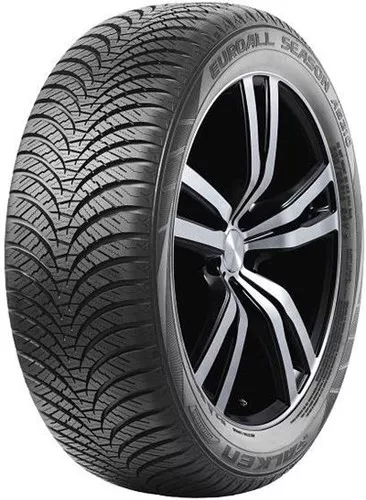
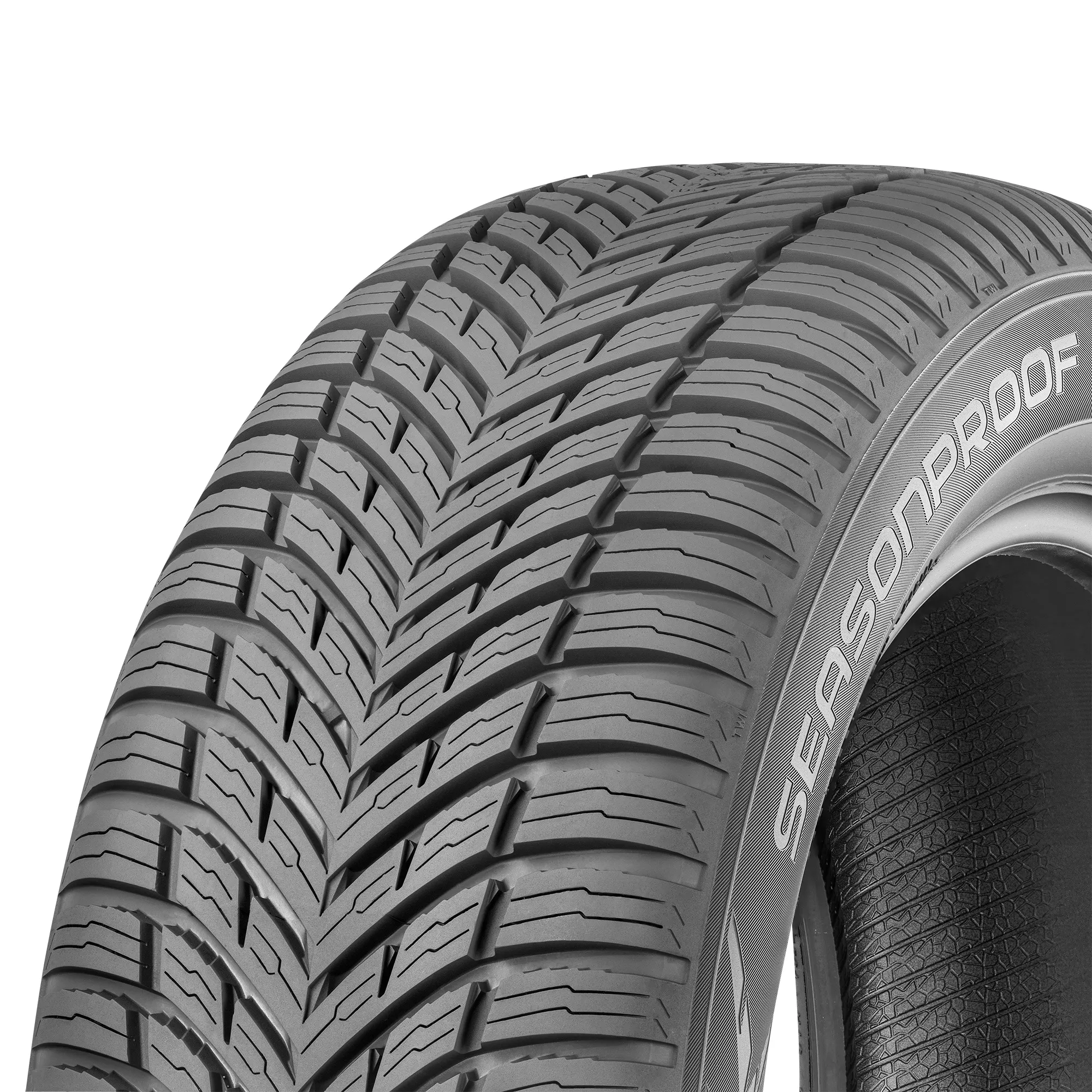
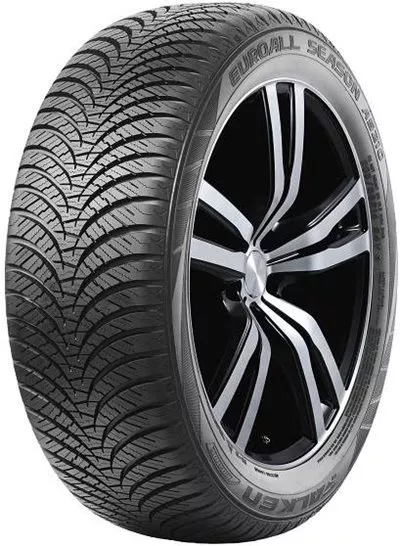
Nokian prioritises snow grip and comfort; Falken counters with shorter average clear-road stops and stronger mileage evidence.
The Nokian Seasonproof and Falken EuroALL Season AS210 offer two distinct interpretations of everyday all-season motoring. The Finnish Nokian has the stronger winter-and-comfort character; the Japanese Falken counters with shorter average braking distances on clear roads and stronger mileage credentials. The AS210 occupies the upper-middle segment and covers 91 dimensions, R13–R20, against the Seasonproof's 41, R14–R19. That gives Falken broader fitment coverage, although suitability still depends on your exact size and specification.
These are conclusions from testing, rather than verified manufacturer design claims: Nokian's supplied official description is an unavailable-page notice, while Falken has no manufacturer description here. No predecessor is identified for either tyre. Nokian's listed successor is the Seasonproof 1, but without comparative results there is no basis for calling it a proven improvement. Between the tested originals, the central choice is clear: prioritise Nokian's snow ability and refinement, or Falken's braking and value proposition.
Seasonproof
EuroALL Season AS210


Averaged from 3 tests
Nokian Seasonproof
Falken EuroALL Season AS210
Nokian Seasonproof
Falken EuroALL Season AS210
Nokian Seasonproof
Falken EuroALL Season AS210
Nokian Seasonproof
Falken EuroALL Season AS210
Nokian Seasonproof
Falken EuroALL Season AS210Across two measured wet-braking tests, Nokian averages 53.0m versus Falken's 51.2m. That 1.8m difference is more substantial than the dry gap and represents additional clearance that could matter when traffic stops suddenly. Falken leads in both underlying measurements: 51.6m against 52.4m in 195/55 R16, and 50.8m against 53.5m in 225/50 R17. Its wet-braking score of 70.6 versus 62.5 supports that result. However, later Falken feedback includes long wet braking and weak wet grip, so the historical advantage should not become a promise of superior stopping in every specification.
Falken's stronger reports describe precise lateral guidance, dynamic wet handling and good lap performance; others identify mild understeer. Nokian receives criticism for understeering wet handling, yet has the stronger overall aquaplaning score, 79.2 against 74.0, supported by repeated positive feedback. The detail scores are closer for straight-line aquaplaning, at 76.7 for Nokian and 77.3 for Falken; Nokian also records 81.8 for cross-aquaplaning. This distinguishes grip on wet asphalt from retaining contact through standing water. Falken's wet-braking advantage does not guarantee better heavy-rain behaviour, especially given repeated aquaplaning criticisms. Nokian offers the more encouraging overall standing-water evidence, although neither tyre makes deep water inconsequential.
Nokian Seasonproof
Falken EuroALL Season AS210
Nokian Seasonproof
Falken EuroALL Season AS210Across two measured dry-braking tests, the Nokian averages 43.9m and the Falken 43.3m. Falken's 0.6m advantage is useful but modest, and less consistent than that average suggests. In 195/55 R16 testing it stopped in 44.4m against Nokian's 46.3m; in 225/50 R17, Nokian stopped in 41.4m against Falken's 42.2m. Starting speeds are not supplied, so these cannot responsibly be presented as stops from 100km/h. The practical message is a small average stopping-margin advantage for Falken, with tyre size and test conditions capable of reversing the order.
Handling tells a different story. Nokian's overall dry score is 73.2 against 58.5, and feedback describes stable dry handling alongside a separate report of understeer. That combination suggests reassuring behaviour within its limits, with the front tyres eventually running wide as cornering demand increases. Falken also receives praise for dry handling, but repeated criticisms of dry grip, braking and understeer prevent a convincing sporting recommendation. The apparent contradiction is informative: cornering stability and straight-line stopping measure different abilities. Nokian can feel composed through bends without generating the strongest braking grip. Neither the supplied construction information nor the feedback establishes a specific compound explanation, sharp steering response or a separate high-speed-stability advantage.
Nokian Seasonproof
Falken EuroALL Season AS210
Nokian Seasonproof
Falken EuroALL Season AS210
Nokian Seasonproof
Falken EuroALL Season AS210
Nokian Seasonproof
Falken EuroALL Season AS210Nokian is the stronger choice when snow becomes a regular part of the journey. Its snow score is 89.6 against Falken's 66.8, supported by feedback identifying excellent snow qualities and convincing behaviour on snow and ice. No snow stopping distances are supplied: the available snow-braking figures are scores, 93.0 for Nokian and 77.5 for Falken. Nokian additionally records 91.5 for acceleration, 87.2 for traction and 89.2 for handling, compared with Falken's 71.2 handling score. Together, those measures support an advantage extending beyond getting moving to controlling speed and direction.
Falken is nevertheless usable in wintry conditions according to several reports, with praise for traction, short snow braking and secure, controllable behaviour. Its weakness is comparative capability: other assessments find average grip, weaker winter performance and understeer on snow. One owner similarly describes lower but predictable snow grip. Nokian owners report successful snow use, although one describes winter performance deteriorating after two years, a useful caution against assuming new-tyre results persist unchanged. Packed-snow-specific measurements and quantitative ice comparisons are absent. Neither tyre's 3PMSF certification is documented in this dataset, so severe-weather marking should be checked on the actual specification rather than inferred from its all-season name.
Nokian Seasonproof
Falken EuroALL Season AS210
Nokian Seasonproof
Falken EuroALL Season AS210Nokian has the more convincing refinement record. Its comfort score of 94.6 and noise score of 95.5 comfortably exceed Falken's 65.2 and 73.9. Test feedback supports pleasant comfort and quiet exterior noise, while eight owner mentions of low noise bring useful everyday corroboration. Exterior measurements do not directly measure cabin sound, however. Falken illustrates the distinction particularly well: one test found the lowest internal noise, while another reported audible cabin noise and below-average ride comfort. Four owner mentions praise its quietness. Expect Nokian to be the safer refinement-led choice, while recognising that vehicle and fitment influence the experience.
Running costs split the verdict. Nokian leads the rolling-resistance scores, 75.5 versus 57.8, and earns explicit praise for low resistance. Falken attracts repeated high-resistance criticism, although one assessment reports low fuel consumption; no defensible fuel-saving percentage follows from this mixed evidence. Nokian's supplied label distribution is 80% A and 20% B for wet grip, with fuel grades 60% C, 20% D and 20% E. Those are specification-dependent label entries, not universal ratings. Falken's label figures are missing. Falken leads mileage scores, 85.3 versus 74.5, and an owner reports 50,000 miles with just under 3mm remaining after twice-yearly rotations. That is encouraging, not a guaranteed lifespan; another test flags projected-mileage weaknesses. Its price and value scores of 90.5 and 88.0, plus a historical €380 fitted-set report for 205/55 R16, strengthen its value case. Nokian earns eight owner value mentions and three durability mentions. Owner averages favour different tyres across platforms: Nokian scores 9.4/10 from 34 and 89/100 from 13 reviews; Falken 9.6/10 from 24 and 86/100 from 30. Without matched prices and wear measurements, Falken's stronger longevity evidence cannot establish an exact lifetime saving.
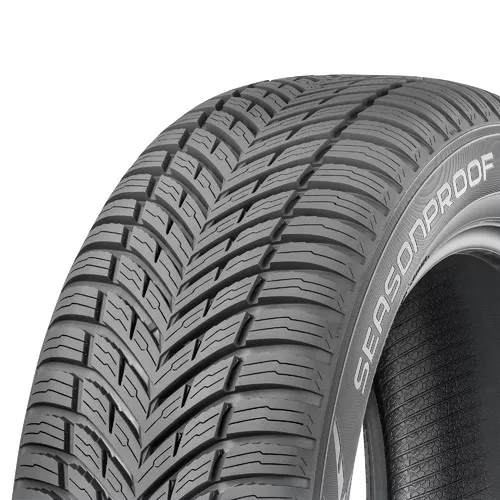
Nokian Seasonproof
Falken EuroALL Season AS210
Nokian Seasonproof
Falken EuroALL Season AS210For everyday driving in a mostly mild climate, I would choose the Falken AS210 between these two. Its shorter average wet stops, smaller dry-braking advantage and stronger mileage evidence address practical priorities for commuters and family motorists. It also finishes ahead in four of five supplied mutual entries, although those include braking qualifiers and full assessments rather than five entirely independent evaluations. The recommendation comes with specific compromises: inconsistent aquaplaning performance, weaker overall snow capability and less dependable comfort. Drivers regularly encountering standing water should give those weaknesses particular weight.
Choose the Nokian Seasonproof when regular snow and a quieter, more comfortable journey matter more. Its winter advantage is supported across braking scores, acceleration, traction and handling, rather than resting on one flattering observation. That makes it the better-supported option for routes that frequently turn snowy, while its refinement suits relaxed everyday driving. The price of that character is repeated criticism of wet and dry stopping distances, including a 1.8m average wet deficit here. Neither tyre earns an unconditional recommendation for enthusiastic dry-road driving. Falken is the pragmatic mild-weather value choice; Nokian is the more persuasive winter-and-comfort specialist.
Compare prices across all available dimensions for these tyres.
VS
VS
VS
VS
VS
VS
VS
VS
VS
VS
Nokian Seasonproof vs Firestone Multiseason 2
Nokian Seasonproof vs Kumho HA32 Solus 4S
Nokian Seasonproof vs Continental AllSeasonContact
Falken EuroALL Season AS210 vs Continental AllSeasonContact
Falken EuroALL Season AS210 vs Hankook Kinergy 4S2 H750
Falken EuroALL Season AS210 vs Maxxis Premitra AS AP3
Falken EuroALL Season AS210 vs Bridgestone Weather Control A005 EVO