Comparison: Goodyear Eagle F1 Asymmetric 6 vs. Hankook Ventus Evo (2026)
Also compare with
Hankook leads on wet braking and value; Goodyear wins mileage, comfort and rolling resistance.
Summer tyre buyers shopping the premium UHP class in 2026 keep landing on the same two names: the Hankook Ventus Evo and the Goodyear Eagle F1 Asymmetric 6. Both are fresh designs from established makers, both sit in the premium segment, and both arrive with strong test pedigrees. Yet they pursue subtly different goals. The Hankook Ventus Evo is the newest evolution from a brand whose products have improved with every generation, and it swings for the fences with class-leading wet performance. The Goodyear Eagle F1 Asymmetric 6 is the sixth chapter in a long-running family, an ultra-high-performance design built in Germany for sports, performance and luxury cars.
The numbers set the tone. On this site the Hankook earns a 99/100 rating against the Goodyear's 93/100, and in five mutual tests the Hankook came out ahead in four to the Goodyear's single win. That looks lopsided, but the gap is narrower than it sounds and the Goodyear answers with the best mileage and a value proposition the Hankook cannot match. The brands themselves come from opposite corners of the map: Hankook from South Korea, Goodyear from the USA, with this Eagle F1 produced in Germany.
Across the next sections we work through the measured braking data, the test panel scores from German and Polish publications, the comfort and running-cost picture, and the real owner reviews, so you can see exactly where each tyre earns its keep.
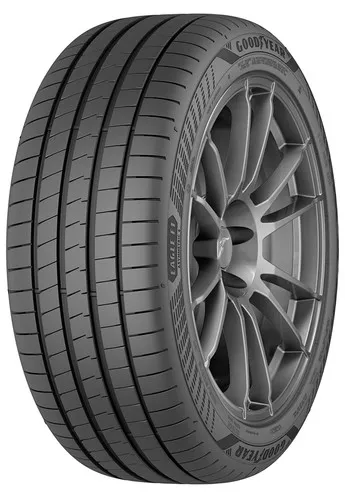
 Eagle F1 Asymmetric 6
 Ventus Evo


These tyres were not tested together. The comparison below is inferred from separate tests by normalizing both tyres against 28 shared benchmark tyres, so treat it as an estimate.
 Goodyear Eagle F1 Asymmetric 6Hankook Ventus EvoGoodyear Eagle F1 Asymmetric 6Hankook Ventus EvoGoodyear Eagle F1 Asymmetric 6Hankook Ventus Evo
Dry performance is where these two are closest. The Hankook posts a dry score of 89.7 to the Goodyear's 89.0, and their dry-braking sub-scores are effectively level at 86.8 and 86.9. In other words, neither tyre will leave you wanting on a warm, dry road, and both stop from speed with confidence. The measured braking averages do separate them: across two mutual tests the Hankook needed 33.4 metres to the Goodyear's 34.3 metres, a useful margin of nearly a full metre in the Hankook's favour. In the individual Autobild 2026 245/45 R19 braking run the Hankook stopped in 32.8 m against the Goodyear's 34.5 m.
Handling tells a more nuanced story. The Hankook's dry-handling detail score of 92.7 is excellent, and German testers praised it as a Fahrdynamiker with exemplary handling on dry and wet surfaces and the shortest dry braking distances in their field. Goodyear counters with the most precise steering: its dry-steering-reaction score of 98.3 is outstanding, and Sportauto 2026 named it the sportiest tyre in the test, citing the highest cornering grip with a very neutral, balanced chassis and direct, precise steering. Goodyear's own ActiveBraking and Eagle F1 technologies target exactly this short-stopping, high-stability behaviour for sports and performance cars.
The caveats are minor. Hankook openly notes its dry braking sits just behind the outright test winners, while Sportauto found the Goodyear could feel nervous and sensitive to load changes at the limit, with a narrow margin before grip ran out. Pick the Hankook for the slightly shorter stop and broader limit; pick the Goodyear if razor-sharp steering response is what makes you smile.
Goodyear Eagle F1 Asymmetric 6Hankook Ventus EvoGoodyear Eagle F1 Asymmetric 6Hankook Ventus EvoGoodyear Eagle F1 Asymmetric 6Hankook Ventus EvoGoodyear Eagle F1 Asymmetric 6Hankook Ventus EvoGoodyear Eagle F1 Asymmetric 6Hankook Ventus EvoGoodyear Eagle F1 Asymmetric 6Hankook Ventus EvoGoodyear Eagle F1 Asymmetric 6Hankook Ventus EvoWet weather is the Hankook's decisive advantage. It scores 87.6 for wet overall versus the Goodyear's 83.2, and the gap widens in braking: a wet-braking sub-score of 90.0 against 82.9. Tyre Reviews recorded the Hankook with the best wet braking in the entire test at 27.66 m, and across two mutual tests it averaged 27.2 m to the Goodyear's 27.9 m. German testers crowned the Ventus Evo their Testsieger specifically for its best-in-class wet properties, short braking distances and dynamic handling.
Aquaplaning reinforces the point. The Hankook scores 81.4 for aquaplaning to the Goodyear's 77.3, and Tyre Reviews logged the highest straight-line aquaplaning speed in the test at 78.81 km/h. Hankook attributes this to lateral shoulder grooves optimised to clear water and a wet-grip compound using specialised resins that tune hysteresis across temperatures. The Goodyear is not weak here, but several testers flagged it as slightly softer in aquaplaning, and Sportauto noted small deficits in lateral aquaplaning.
The Goodyear still deserves credit. ADAC 2025 and Autobild called it a balanced tyre with good wet characteristics, strong safety reserves and good lateral guidance, and its EU wet-grip label is essentially all A-rated (A-98). Autobild 2025 did, however, place its wet braking only in the midfield. The summary is straightforward: both are safe in the rain, but if you live somewhere genuinely wet, the Hankook is the stronger and more reassuring choice.
Goodyear Eagle F1 Asymmetric 6Hankook Ventus EvoGoodyear Eagle F1 Asymmetric 6Hankook Ventus EvoComfort and running costs flip the script and hand the Goodyear its clearest wins. Subjectively the Hankook scores higher for overall comfort (84.5 vs 72.1) and exterior noise (87.5 vs 80.2), with Tyre Reviews measuring a very low 70.7 dB pass-by. Yet in the panel detail scores the Goodyear earns a superb 92.3 for ride comfort, and Sportauto 2026 rated it the best for ride comfort at a perfect 10/10 and the quietest in the test at 68.1 dB(A). Read together, both are refined; the Hankook is the more consistently quiet performer across publications, while the Goodyear can be the plushest in the right size.
Running costs are where the Goodyear shines. Its mileage score of 86.5 dwarfs the Hankook's 77.5, and one panel scored the Goodyear a maximum 100 for mileage; Autobild called it the Eco-Meister with the highest predicted mileage and the best tyre in the cost chapter. Rolling resistance favours it too, at 77.6 versus 76.0, with Sportauto measuring the best rolling resistance among premium tyres at 8.4 kg/t. By contrast, the Hankook's higher rolling resistance is its one acknowledged weakness, sitting near the bottom of the Tyre Reviews field at 8.76 kg/t.
The EU labels broadly reflect this. The Goodyear spreads its fuel-economy ratings across A, B and C grades (21% A, 30% B), while the Hankook is mostly C (80%) with some A and B. On wet grip both are dominated by A grades. On value, the Hankook is repeatedly praised for a great price-to-performance ratio and a near-premium tyre for less than a premium price, whereas the Goodyear scores an even higher price-value detail score of 93.7 despite testers flagging its high purchase price. If total cost of ownership and longevity matter most, the Goodyear is the smarter spend; if upfront value matters most, the Hankook leads.
Goodyear Eagle F1 Asymmetric 6Hankook Ventus EvoGoodyear Eagle F1 Asymmetric 6Hankook Ventus EvoGoodyear Eagle F1 Asymmetric 6Hankook Ventus EvoGoodyear Eagle F1 Asymmetric 6Hankook Ventus EvoGoodyear Eagle F1 Asymmetric 6Hankook Ventus EvoGoodyear Eagle F1 Asymmetric 6Hankook Ventus EvoGoodyear Eagle F1 Asymmetric 6Hankook Ventus EvoGoodyear Eagle F1 Asymmetric 6Hankook Ventus EvoGoodyear Eagle F1 Asymmetric 6Hankook Ventus EvoGoodyear Eagle F1 Asymmetric 6Hankook Ventus EvoGoodyear Eagle F1 Asymmetric 6Hankook Ventus EvoGoodyear Eagle F1 Asymmetric 6Hankook Ventus EvoThis is a contest between a wet-weather and value champion and a long-distance, refinement-focused all-rounder. The Hankook Ventus Evo wins the head-to-head record (four mutual tests to one), the wet braking, the aquaplaning and the up-front value, and it does so while staying very quiet and handling with genuine sporting confidence. Its only real blemishes are higher rolling resistance and dry braking that sits a touch behind the very best. For most drivers in a variable climate, it is the safer and more rounded buy, which is why it tops our ratings at 99/100.
The Goodyear Eagle F1 Asymmetric 6 is no runner-up by accident. It offers the sharpest steering, the longest predicted mileage, the lowest rolling resistance and outstanding owner satisfaction, with a Heureka rating of 10/10 and a Tyre Reviews average of 98/100. Owners moving up from the Asymmetric 5, or across from Pirelli and Michelin rivals, describe improved handling, lower noise and night-and-day comfort gains. Its weaknesses are a higher price, slightly softer aquaplaning and a limit that can feel nervous when pushed hard.
Choose the Hankook for wet safety, the better braking record and stronger value. Choose the Goodyear if you cover big annual mileage, prize steering precision and want the lowest long-term running costs. Both are premium tyres that will not disappoint.
Compare prices across all available dimensions for these tyres.
 VS
VS VSVSVS
 VSVS
VSVS VSVSVSVSGoodyear Eagle F1 Asymmetric 6 vs Bridgestone Potenza SportGoodyear Eagle F1 Asymmetric 6 vs Pirelli P ZERO PZ4Goodyear Eagle F1 Asymmetric 6 vs Bridgestone Turanza T005Goodyear Eagle F1 Asymmetric 6 vs Bridgestone Turanza 6Hankook Ventus Evo vs Continental PremiumContact 7
 Hankook Ventus Evo vs Kumho Ecsta Sport (PS72)Hankook Ventus Evo vs Bridgestone Potenza Sport Evo