Bridgestone wins on every measured safety metric; Fortuna only wins on sticker price.
On paper, both of these are all-season tyres chasing the same buyer — someone who wants one set of rubber for the whole year. In reality, they're built for almost opposite audiences. The Fortuna Eco Plus 2 4S is a lowcost-segment all-rounder from Fortuna, sold across a huge 99-size range and pitched squarely at price-conscious drivers who just need 3PMSF and M+S certification to satisfy winter-tyre laws without paying premium money. The Bridgestone Turanza All Season 6 sits at the opposite end of the market: a premium touring tyre from Bridgestone, developed and manufactured in Europe, arriving relatively late to the all-season segment specifically to compete for the demanding HRD (high-rim-diameter) buyer who wants near-summer-tyre dry manners without giving up winter usability.
The gulf in our own ratings — 7/100 for the Fortuna versus 90/100 for the Bridgestone — is about as stark a starting point as a comparison can have, and the independent test data backs that gulf up almost point for point. Bridgestone explicitly positions the Turanza All Season 6 as covering '96% of demand in the premium HRD all-season touring category,' aimed at drivers who avoid extreme winter conditions or mostly do short urban trips; Fortuna makes no such claims and doesn't need to — its job is simply to be cheap and legally compliant.
The single biggest character difference: the Bridgestone is engineered as a genuine four-season performance tyre with sacrifices made deliberately and communicated openly (Bridgestone itself flags 'average on snow' as a weakness), while the Fortuna is a budget tyre whose on-paper scores look surprisingly competitive but whose real-world test results, where they exist, tell a much harsher story.
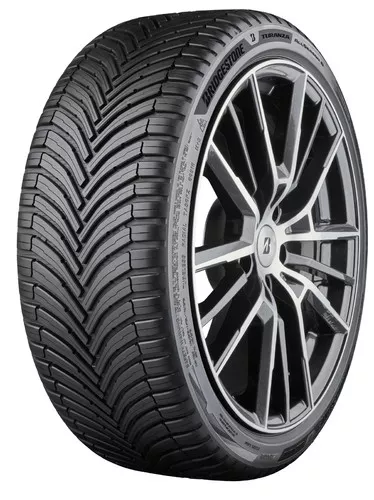
Eco Plus 2 4S
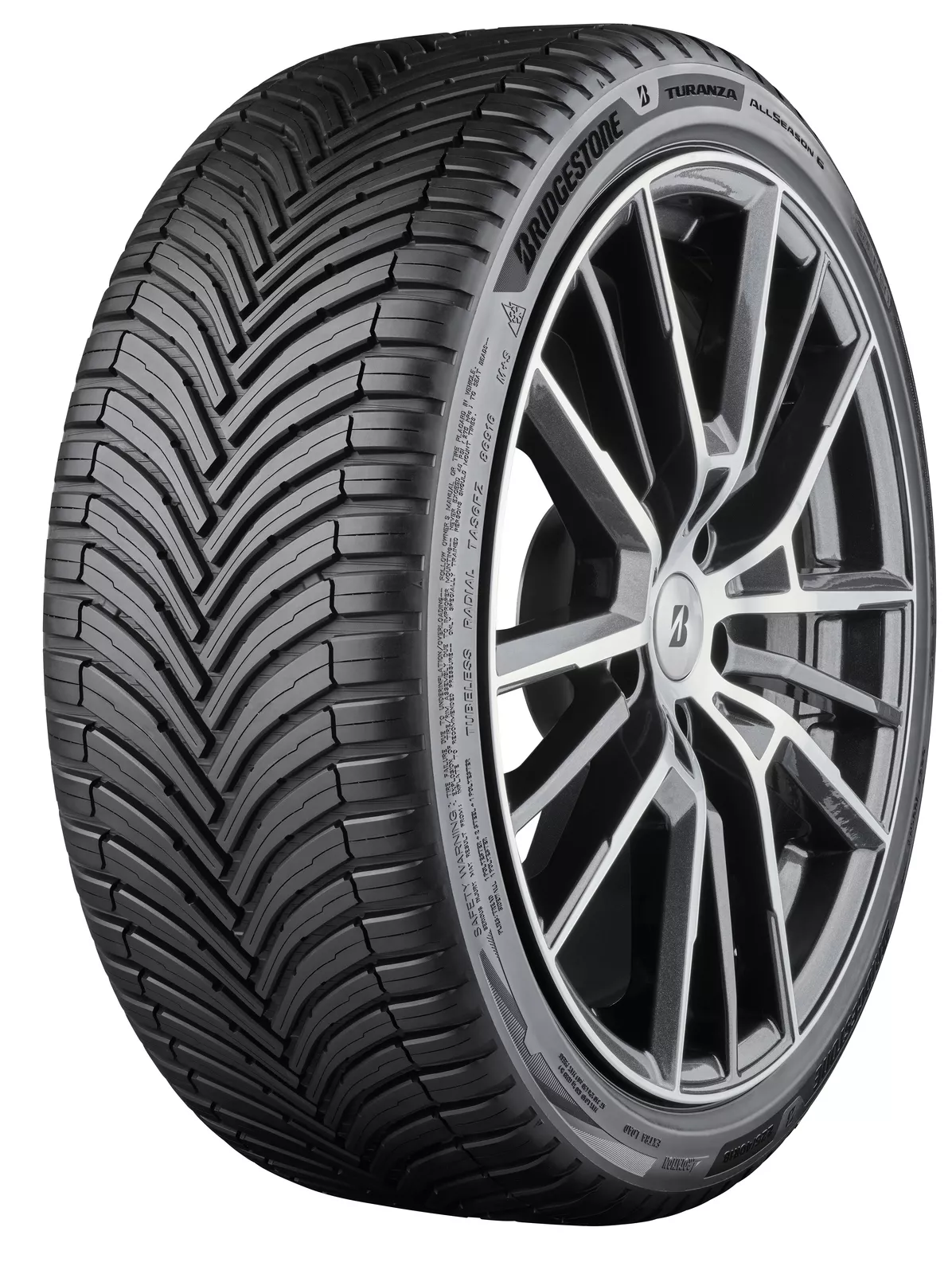
Turanza All Season 6


Fortuna Eco Plus 2 4S
Bridgestone Turanza All Season 6
Fortuna Eco Plus 2 4S
Bridgestone Turanza All Season 6
Fortuna Eco Plus 2 4S
Bridgestone Turanza All Season 6
Fortuna Eco Plus 2 4S
Bridgestone Turanza All Season 6The wet-weather gap is even more dramatic than the dry one. In the same Autobild 2024 test, the Fortuna needed 68.9m to stop from wet-braking speed, while the Bridgestone needed just 50.5m — an 18.4-metre difference, meaning the Bridgestone would already be stationary for roughly four car lengths before the Fortuna even reaches the same point. Bridgestone's marketing claim of 'best wet braking performance in its class' (TUV SUD tested) is backed up independently: Die Reifentester measured 31.2m in its own wet-braking test, and the brand's avg-test wet-braking detail score sits at 85.7, more than nine points clear of the Fortuna's 76 wet-braking score.
Aquaplaning resistance follows the same pattern. The Bridgestone's aquaplaning score of 81.9 and avg-test longitudinal-aquaplaning figure of 85.6 are backed by Die Reifentester's note of 'solid aquaplaning figures' and 'good lateral aquaplaning,' while the Fortuna's aquaplaning score of 76.5 sits meaningfully lower with no independent measured corroboration in the data available. Real owners largely echo the Bridgestone's wet-weather competence too — one reviewer specifically praised confident wet acceleration on a Suzuki Vitara, and another noted the tyre performs 'almost like a summer tyre' in the dry with strong wet handling to match — though it's worth noting one long-term owner reported an unnerving four-wheel slip through a wet roundabout after roughly a year of use, a reminder that even a strong-testing tyre can surprise as it wears.
Bridgestone isn't flawless in the wet — Automotorsport 2026 flagged it as 'somewhat sensitive to load changes' and Die Reifentester noted it felt 'overloaded in tight wet curves' in one test — but these are refinements at the margins of a genuinely capable tyre. The Fortuna's much longer wet braking distance and lower aquaplaning score point to a tyre that, in an actual wet-weather emergency, simply asks the driver to accept a significantly longer margin for error.
Fortuna Eco Plus 2 4S
Bridgestone Turanza All Season 6
Fortuna Eco Plus 2 4S
Bridgestone Turanza All Season 6In the one mutual braking test with metres data (Autobild 2024, 37 tyres), the Bridgestone stopped in 36.8m on dry tarmac against the Fortuna's 42.4m — a gap of 5.6 metres, or well over a car length, from the same speed. That single measured result lines up with the wider field: the Bridgestone finished in 1st place in that 37-tyre test while the Fortuna finished 30th, and Tyre Reviews 2026 separately clocked the Bridgestone in 2nd place for dry braking at 36.1m. Die Reifentester's independent 37.7m dry stop for the Bridgestone corroborates the same story from a third test house, which is the kind of cross-referenced consistency that turns one good result into a genuine characteristic rather than a fluke.
Bridgestone's own avg-test-detail dry-handling-objective score of 97.5 explains why testers keep reaching for superlatives — Automotorsport 2026 called it 'the sportiest tyre in the test in summer-dry conditions,' and Autobild 2025 praised it for finding 'the golden mean across all disciplines' while being 'particularly safe in dryness.' That kind of composure comes from a tyre tuned to behave like a genuine summer performance tyre first, with all-season certification layered on top rather than the reverse — which is precisely why Bridgestone can market it to drivers who 'avoid extreme winter conditions' rather than to snow-country buyers.
The Fortuna's on-paper dry score of 89 (with a dry-braking score of 90) looks respectable in isolation, but it doesn't survive contact with real test data — the 42.4m stopping distance and 30th-of-37 finish are what actually happened on tarmac, not what a marketing scorecard suggests. That disconnect between headline numbers and measured performance is a recurring theme with budget all-season tyres, and it's the first sign that the Fortuna's real-world dry manners lag well behind its spec sheet.
Fortuna Eco Plus 2 4S
Bridgestone Turanza All Season 6
Fortuna Eco Plus 2 4S
Bridgestone Turanza All Season 6
Fortuna Eco Plus 2 4S
Bridgestone Turanza All Season 6
Fortuna Eco Plus 2 4S
Bridgestone Turanza All Season 6Snow is the category where Bridgestone is most candid about its own limitations. The Turanza All Season 6 posts an avg-test snow-handling-objective score of 87, but Autobild 2025 noted it's 'somewhat weaker on snow,' Automotorsport 2026 called it 'comparatively weak on snow and wet roads,' and Die Reifentester scored its timed snow handling at just 69 points — its lowest discipline by a clear margin, and Tyre Reviews 2026 placed it ninth of the field for timed snow handling. This is a deliberate trade-off: Bridgestone markets the tyre toward drivers who 'avoid extreme winter conditions,' and the data confirms that snow is where the sportier dry/wet-focused construction gives something back.
The Fortuna carries the same 3PMSF snowflake and M+S markings, and its snow score of 84 is actually higher than the Bridgestone's 75.5 headline snow figure on paper. Without independent snow-braking metres data for either tyre in this comparison, it's hard to fully verify that gap, but it's plausible — budget all-season tyres are often tuned with a softer, more traction-oriented compound precisely because outright dry/wet grip isn't the priority, and snow performance is one area where that trade-off can occasionally work in a cheaper tyre's favour.
Still, given how far behind the Fortuna falls on measured dry and wet braking, a nominally better snow score shouldn't be read as an overall advantage. Both tyres are legally compliant for winter use in markets that require 3PMSF certification, but a tyre that stops 18 metres later in the wet is not one you want to lean on once the snow melts and the roads turn merely damp, which is most of a typical winter.
Fortuna Eco Plus 2 4S
Bridgestone Turanza All Season 6
Fortuna Eco Plus 2 4S
Bridgestone Turanza All Season 6Comfort is genuinely competitive rather than a Bridgestone sweep. The Fortuna's comfort score of 86 actually edges the Bridgestone's 81.4, and Fortuna's noise score of 86 also beats Bridgestone's 85 on paper. But independent testing complicates that picture: Die Reifentester specifically measured the Bridgestone as having the 'lowest noise measurement overall' in its test field alongside 'acceptable ride comfort,' which suggests the Bridgestone's real-world refinement is stronger than its raw comfort score implies — Autobild 2025 did note 'slight concessions on comfort and noise development,' so it's not without trade-offs, but it isn't the noisy, harsh-riding tyre a straight scorecard comparison might suggest either.
Running costs are where the story flips decisively toward the Fortuna on cost, if not necessarily on value. The Fortuna's rolling-resistance score of 88 is well ahead of the Bridgestone's 68, and Die Reifentester measured the Bridgestone at a field-high 9.05 kg/t rolling resistance, reflected in its C-rated EU fuel label (with some sizes at B or D). Bridgestone doesn't hide this — 'higher rolling resistance' is listed among its own acknowledged weaknesses. That means real fuel or energy consumption penalties for Bridgestone owners, which matters over tens of thousands of kilometres.
But rolling resistance is only half the running-cost equation, and mileage is where Bridgestone claws it back. The Turanza All Season 6 posts a mileage score of 78.5 and Bridgestone claims '20% improved tread life compared to predecessor' — no equivalent mileage figure is available for the Fortuna, but a tyre finishing 30th of 37 in dry braking and posting an 18-metre-longer wet stop is unlikely to be built to the same durability standard as a premium touring tyre. Combined with the Bridgestone's B-rated EU wet-grip label (versus no rating data for the Fortuna) and its EV-ready Enliten technology, the Bridgestone's higher purchase price buys measurably more capability and, very plausibly, more tyre life — the Fortuna is cheaper to buy and cheaper to roll on, but the safety and longevity trade-offs are real, not theoretical.
Fortuna Eco Plus 2 4S
Bridgestone Turanza All Season 6The head-to-head record settles this cleanly: across the two mutual tests, the Bridgestone won both, including an outright 1st-place finish in a 10-tyre Autobild test where the Fortuna finished dead last with a 'not recommended' verdict, and a 1st-place finish out of 37 tyres in the Autobild braking test where the Fortuna finished 30th. This isn't a close contest decided by taste — it's a measurable, repeated gap in the fundamentals of stopping a car in both dry and wet conditions, exactly the moments where tyre choice matters most.
Buy the Bridgestone Turanza All Season 6 if you want a genuinely premium all-season tyre that drives close to a dedicated summer tyre in the dry, leads its class in wet braking and aquaplaning resistance, and offers real EV-ready technology and improved tread life to offset its higher price — it's the clear choice for drivers in temperate climates who see occasional light snow but prioritize year-round grip and safety above all else. Just budget for the premium price tag, the higher rolling resistance, and accept that outright snow performance, while certified and adequate, isn't its strongest suit.
| Organization | Season | Year | Dimension | |
|---|---|---|---|---|
Autobild | All season | 2025 | 215/50 R18 | View |
Compare prices across all available dimensions for these tyres.
VS
VS
VS
VS
VS
VS
VS
VS
VS
VS