Comparison: Firestone Roadhawk 2 vs. Uniroyal RainSport 5 (2026)
Also compare with
Firestone is the efficient all-rounder; Uniroyal trades dry precision for stronger everyday wet grip.
Firestone Roadhawk 2 is an upper-middle-segment summer tyre aimed at everyday drivers who want dependable safety without premium-brand pricing. Available in 108 sizes from R16 to R22 and made in Italy, it replaces the Firestone Roadhawk. Firestone positions it for commuting, extended road trips and active lifestyles, including electric-vehicle use. Its ENLITEN construction, lightweight carcass and high-silica NanoPro-Tech compound are intended to reconcile wet grip, wear and rolling resistance.
Uniroyal RainSport 5 occupies the same upper-middle territory but follows a more specialised brief. Offered in 102 sizes from R15 to R21, it is the rain-focused option in the Uniroyal range. Shark Skin Technology, wide in-block grooves and Aqua-Twist sipes are all designed to move water away from the contact patch. The manufacturer also promises mileage, control and steering response, although the independent evidence supports its wet-weather claims more convincingly than its dry-handling message.
The defining difference is that the Roadhawk 2 is the more balanced efficiency-led all-rounder, while the RainSport 5 sacrifices dry precision to become the more reassuring wet-grip tyre. Firestone won their sole common six-tyre test, finishing third against Uniroyal in fourth, and carries the stronger overall rating of 83/100 versus 69/100. That result should not obscure the split in character: Firestone has exceptional resistance to standing water and low energy losses in favourable tests, whereas Uniroyal supplies stronger wet braking and a softer, more comfortable road manner.
 Roadhawk 2
 RainSport 5


These tyres were not tested together. The comparison below is inferred from separate tests by normalizing both tyres against 14 shared benchmark tyres, so treat it as an estimate.
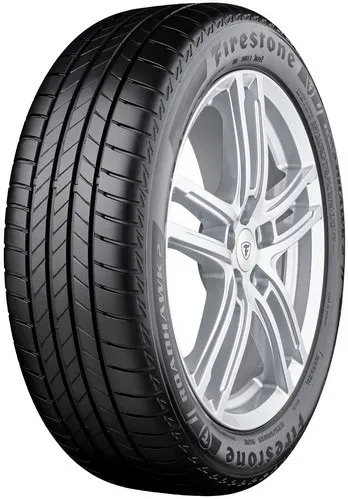
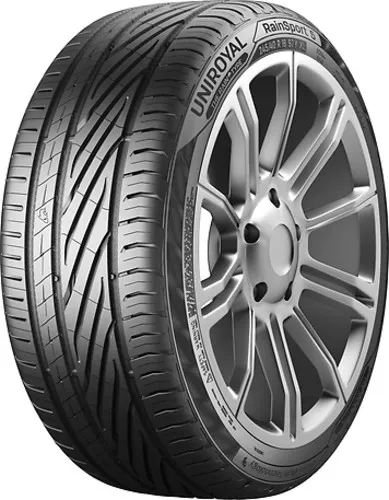 Firestone Roadhawk 2Uniroyal RainSport 5Firestone Roadhawk 2Uniroyal RainSport 5Firestone Roadhawk 2Uniroyal RainSport 5Firestone Roadhawk 2Uniroyal RainSport 5
No valid average dry braking distance can be calculated from the supplied data: the required avg_braking_distances_metres values and comparable measured-test counts are absent for both tyres. The available indices put the RainSport 5 ahead in dry braking, at 72.3 versus 66.5, but these are scores rather than metres. One Roadhawk 2 test recorded 35.4 metres and last place, while another ranked it seventh for dry braking. Those results make clear that Firestone's balanced character does not translate into class-leading stopping power.
The broader dry scores are more nuanced. RainSport 5 records 68 against Roadhawk 2's 61.5, yet Uniroyal repeatedly attracts criticism for slow dry laps, vague responses and restricted lateral support. Its soft, rain-oriented tread appears to deform more under steering and cornering loads, so direction changes feel less immediate and the car takes longer to settle. That matters on a fast B-road or during an emergency lane change: the tyre may generate acceptable longitudinal grip, but it communicates and supports cornering loads less convincingly.
Roadhawk 2's connected shoulder blocks and pressure-distribution strategy give it a more coherent dry personality. Its dry-handling average is 73.8 and dry lane-change score 80, with good cornering security among the recurring positives. Nevertheless, delayed steering response, weak feedback and limited ultimate reserves prevent it from feeling genuinely sporting. It is the calmer choice for sustained motorway speeds and ordinary brisk driving, but its 35.4-metre result shows why drivers should not confuse composure with abundant emergency grip. Neither tyre is ideal for track use; Firestone is the more orderly all-round chassis partner, while Uniroyal's softer reactions are the larger dynamic compromise.
Firestone Roadhawk 2Uniroyal RainSport 5Firestone Roadhawk 2Uniroyal RainSport 5Firestone Roadhawk 2Uniroyal RainSport 5Firestone Roadhawk 2Uniroyal RainSport 5Firestone Roadhawk 2Uniroyal RainSport 5Firestone Roadhawk 2Uniroyal RainSport 5The supplied material again lacks comparable average wet braking distances and test counts, so inventing a metre average would be misleading. The scores nevertheless show a decisive advantage for RainSport 5: 80.5 for wet braking and 84.3 for overall wet performance, against Roadhawk 2's 66.7 and 73.9. Firestone recorded 38.3 metres in one wet-braking test and 51.1 metres under another test protocol; because the speeds and methods are not stated, those figures cannot responsibly be averaged. It was also 2.1 metres behind the best tyre in a separate comparison, a gap approaching half a typical car length.
Standing-water performance reverses the emphasis. Roadhawk 2 scores 92.6 for aquaplaning, fractionally ahead of RainSport 5's 91.8. Its cross-aquaplaning average is 94 versus 92.8, and longitudinal performance is 91.2 versus 90.9. Firestone won both aquaplaning disciplines in one test and produced a class-leading 2.44 m/s² result while cornering through water in another. Its void-to-rib balance, chamfered sipes and wide shoulder lugs evidently evacuate large volumes of water effectively. Uniroyal remains outstanding: it achieved the best curved-aquaplaning grade of 1.4 in their common test, confirming that the precise winner varies with surface and procedure.
The important distinction is between resisting aquaplaning and gripping on merely wet asphalt. Firestone is exceptionally difficult to lift onto a film of water, making it highly reassuring through deep motorway ruts, but its limited adhesion reserve, unstable wet load-change behaviour and weak feedback can appear before aquaplaning begins. RainSport 5 couples a wet-handling score of 80.4 with wet-circle cornering of 79, narrowly above Firestone's 79.7 and 76. It therefore brakes, turns and holds a wet line more naturally, while its grooves and sipes preserve excellent deep-water security. Owners reinforce this picture: wet grip and aquaplaning resistance were mentioned positively 17 times. For persistent rain, Uniroyal is the more confidence-inspiring package; for sudden deep standing water, Firestone is at least its equal and sometimes better.
Firestone Roadhawk 2Uniroyal RainSport 5Firestone Roadhawk 2Uniroyal RainSport 5Firestone Roadhawk 2Uniroyal RainSport 5RainSport 5 has the small comfort advantage, scoring 81.2 overall against Roadhawk 2's 79.8. Its dedicated comfort average is 81.3, and it earned the best ride-comfort grade of 2.0 in their common test. The softer compound and compliant tread that blur dry steering also round off sharp joints and coarse surfaces. Roadhawk 2 can transmit slightly more road texture, with minor ride deficiencies noted, but remains refined. Noise scores favour Firestone by 83.2 to 81.2; it was the quietest tyre in one complete comparison, while Uniroyal recorded the lowest exterior pass-by noise in another. Both are credible long-distance choices, with no evidence of an intrusive cabin-noise problem.
Firestone's strongest running-cost argument is efficiency. Its rolling-resistance score is 74.8 against Uniroyal's 68.8, and it achieved a test-best 8.0 kg/t in one comparison plus third place in another. Its EU fuel labels are B for 70% of listed sizes, C for 27% and A for 3%; 99% carry an A wet-grip label. Firestone claims 12% lower rolling resistance and 20% greater mileage than the previous Roadhawk, attributing the change to ENLITEN, the light carcass and high-silica compound. The efficiency improvement looks genuine, although not universal: another test found high resistance and fuel consumption, probably reflecting size and construction differences.
Longevity is the Roadhawk 2's unresolved weakness. Its mileage score is only 38, and restricted projected life was a prominent criticism, so the official 20% generation-on-generation improvement does not necessarily make it durable beside current rivals. RainSport 5 scores a healthier 61.6 for mileage and 69.5 for price-to-value, while nine owner mentions praise its affordability. Yet its official cost-saving and extended-life message is also challenged by reports of low mileage and high fuel use; two owners specifically identify the softer compound. Owner sentiment is divided: 50 Heureka reviews average an excellent 9.6/10, whereas 60 TyreReviews ratings average only 59/100. Firestone's recorded price of €132 was considered favourable, but no directly comparable Uniroyal price is supplied. Firestone should consume less energy, particularly in an efficient size; Uniroyal may return more tread life according to the aggregate score, though neither has an unqualified durability case.
Firestone Roadhawk 2Uniroyal RainSport 5Firestone Roadhawk 2Uniroyal RainSport 5RainSport 5 is the recommendation for drivers who regularly face sustained rain. Its sizeable wet-performance and wet-braking score advantages matter more in routine wet emergencies than the tiny difference between their already excellent aquaplaning scores. It also rides more softly and has the stronger mileage score. Choose it for a family car, daily commute or rural journey in a wet climate, accepting that quick dry direction changes will feel vague and that fuel use may be higher.
Roadhawk 2 is the better option for mixed-weather motorway mileage, electric vehicles and drivers prioritising noise and energy efficiency. It is exceptionally resistant to aquaplaning, has more disciplined dry handling than Uniroyal's soft responses suggest, and finished ahead in their only direct comparison. Its broad R16–R22 range also reaches larger wheels than the Uniroyal range. The trade-offs are serious: measured braking results can be long, wet load changes expose limited reserves, and projected tread life undermines part of the sustainability pitch.
Overall, the Roadhawk 2 is the more rounded tyre and earns the narrow general recommendation, consistent with its 83/100 rating and head-to-head victory. However, the choice changes in a genuinely rainy climate: there, RainSport 5's stronger braking and usable wet grip outweigh its dry imprecision. In short, buy Firestone for balanced everyday efficiency and deep-water security; buy Uniroyal when wet-road stopping confidence is the overriding priority.
Compare prices across all available dimensions for these tyres.
| Organization | Season | Year | Dimension | |
|---|---|---|---|---|
 Netzwelt Netzwelt | Summer | 2026 | 205/55 R16 | View |
 VS
VS
 VSVSVS
 VSVS
VSVS VSVS
VSVS VSVS
VSVS










