Comparison: Firestone Roadhawk 2 vs. Hankook Ventus Prime 4 (2026)
Also compare with
Hankook stops shorter and lasts longer; Firestone leads only on aquaplaning.
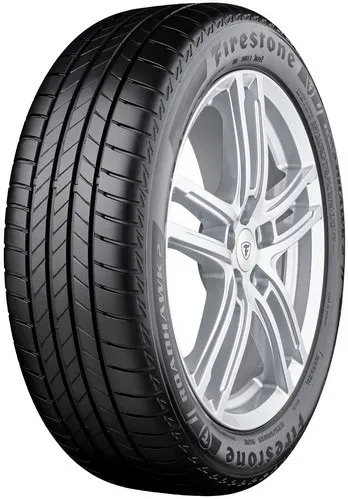
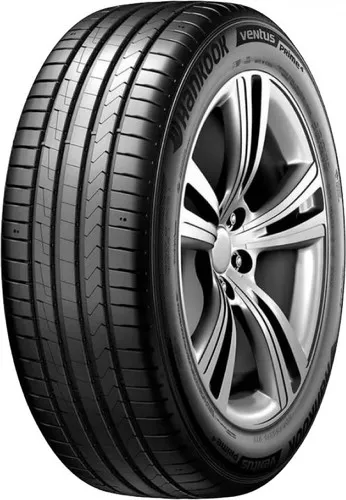
On paper, Firestone and Hankook are aiming at similar buyers — the everyday driver who wants a competent, safe summer tyre without paying flagship prices. In practice, the Firestone Roadhawk 2 and the Hankook Ventus Prime 4 have arrived at that destination by very different routes, and the characters they've built along the way could not be more distinct. The Roadhawk 2, successor to the original Firestone Roadhawk, carries Bridgestone's ENLITEN technology — a compound and construction approach designed to minimise rolling resistance and extend tyre life while delivering honest, predictable behaviour on both wet and dry surfaces. It sits in the upper-middle segment, offering premium-group technology at a friendlier price point, with 108 size options spanning R16 to R22. The Ventus Prime 4 is Hankook's answer to the same question from the premium segment: the direct evolution of the Ventus Prime3 K125, it arrives in 97 sizes from R13 to R22, and Hankook positions it squarely as an everyday safety-focused tyre with an emphasis on short braking distances and balanced dynamic behaviour.
The single biggest difference in character? The Roadhawk 2 is, quite simply, one of the finest aquaplaning-resistance tyres in its segment — a tyre that floats across standing water with remarkable composure — but pays for that hydroplaning mastery with modest grip at the limit and longer braking distances than you might expect from its EU wet grip label. The Ventus Prime 4 inverts that trade: it stops shorter, handles more dynamically, and covers ground more quietly, but its aquaplaning reserves are noticeably weaker and its mileage advantage over the Firestone is surprisingly modest given how it positions itself. Understanding those fundamental contrasts is the key to knowing which one belongs on your car.
 Roadhawk 2
 Ventus Prime 4


These tyres were not tested together. The comparison below is inferred from separate tests by normalizing both tyres against 15 shared benchmark tyres, so treat it as an estimate.
 Firestone Roadhawk 2Hankook Ventus Prime 4Firestone Roadhawk 2Hankook Ventus Prime 4Firestone Roadhawk 2Hankook Ventus Prime 4Firestone Roadhawk 2Hankook Ventus Prime 4Firestone Roadhawk 2Hankook Ventus Prime 4
Dry performance is where the gap between these two tyres is most pronounced, and where choosing the wrong one will have the most immediate, tangible consequences. The Hankook Ventus Prime 4 carries a dry braking performance score of 85.6 and an objective dry-handling score of 97.5 — both figures that place it comfortably among the stronger performers in its class. The Firestone Roadhawk 2 scores 65.0 for dry braking, a gap of more than 20 points that translates directly into longer stopping distances when it matters most. In Sportauto's 2026 test, the Roadhawk 2 recorded a dry braking distance of 35.4 metres — finishing last in the group — a result that testers flagged explicitly as a weakness. That same test gave the Roadhawk 2 a dry-handling score of 69.8, confirming that the weaker braking is part of a broader picture of modest absolute grip rather than an isolated anomaly.
The Hankook's advantage at the limit is consistent across the test data: its wet-handling objective score of 87.5 and dry-handling objective of 97.5 point to a tyre that is genuinely dynamic, with neutral, safe wet and dry handling and short dry braking distances confirmed across multiple campaigns including ADAC 2026 and multiple Autobild evaluations. Real owners back this up enthusiastically — one driver who switched from a Continental SportContact 2 reported the Ventus Prime 4 operating at the grip limit roughly 20 km/h higher than his previous tyres, with no understeer regardless of what he threw at it. That is the hallmark of a tyre with genuine grip reserves, not just honest limits. The Roadhawk 2, by contrast, has been criticised for delayed steering response, low grip reserves, and unstable load-change behaviour — the kind of characteristics that make a tyre feel vague and reactive rather than communicative and precise. For drivers who want to feel connected to the road, the Hankook is the clear choice.
Where the Roadhawk 2 does hold its own on dry roads is the ADAC 2026 test, where it finished a creditable 4th out of 16 tyres against the Hankook's 11th — a result partly explained by the Hankook's notably weaker wet performance in that particular test dragging its aggregate score down. On a purely dry track, the Roadhawk 2's performance is adequate for everyday driving; the limits only become relevant when you need to stop hard in an emergency. And that, ultimately, is the metric that matters most.
Firestone Roadhawk 2Hankook Ventus Prime 4Firestone Roadhawk 2Hankook Ventus Prime 4Firestone Roadhawk 2Hankook Ventus Prime 4Firestone Roadhawk 2Hankook Ventus Prime 4Firestone Roadhawk 2Hankook Ventus Prime 4Firestone Roadhawk 2Hankook Ventus Prime 4Firestone Roadhawk 2Hankook Ventus Prime 4Firestone Roadhawk 2Hankook Ventus Prime 4Wet performance is the most complex dimension of this comparison, because the two tyres are genuinely strong in different aspects of wet-road behaviour. The Hankook Ventus Prime 4 posts a wet braking score of 81.1 and a wet handling score of 84.7 — figures that confirm short, confident stops in the rain and a tyre that responds precisely when you need to change direction on a slippery surface. The Firestone Roadhawk 2 scores 65.4 for wet braking — a significant deficit. In Netzwelt's 2026 test, the Roadhawk 2 recorded a wet braking distance of 51.1 metres; Sportauto's 2026 test recorded 38.3 metres — a spread that reflects different test conditions and speeds, but in both cases resulted in penalties or criticism from testers. The Hankook's wet braking advantage translates to multiple car lengths of stopping distance in real emergency situations, which is safety-critical rather than merely academic.
But the picture reverses dramatically when standing water enters the equation. The Roadhawk 2's aquaplaning scores are extraordinary: 92.8 for cross-aquaplaning and 89.4 longitudinally, against the Hankook's 74.4 overall aquaplaning score (longitudinal: 78.9). In Sportauto's 2026 test the Roadhawk 2 topped the entire field for curved aquaplaning resistance at 2.44 m/s², finishing first — a result that confirms the ENLITEN compound and tread pattern have been engineered with water evacuation as a genuine priority. The Hankook's EU wet grip label tells part of the story here: 54% of its variants achieve an A rating, with 36% rated B and a further 10% rated C or D — a much wider spread than the Roadhawk 2, where 98% of variants carry an A. In torrential rain on a motorway, the Roadhawk 2's aquaplaning reserves provide a meaningful margin of safety that the Hankook cannot match.
The practical consequence of this split is that the tyres are genuinely complementary in the wet: the Hankook is better when the road is damp but grippy, demanding confident stops and precise cornering; the Roadhawk is safer when the road is flooded or waterlogged, where aquaplaning resistance trumps grip at the limit. Most European driving involves more of the former than the latter, which is why the Hankook's overall wet performance score of 81.4 against the Roadhawk's 72.2 gives a fair overall picture — but drivers who regularly encounter heavy standing water should weigh the aquaplaning deficit in the Hankook very seriously.
Firestone Roadhawk 2Hankook Ventus Prime 4Firestone Roadhawk 2Hankook Ventus Prime 4The Hankook Ventus Prime 4 is the more refined choice for daily driving, and the data is unambiguous on this. Its comfort score of 80.0 and noise score of 77.3 comfortably surpass the Roadhawk 2's 69.7 and 49.5 respectively — the noise gap in particular is stark, and it translates to a noticeably quieter cabin on motorways and A-roads. Real-world owners of the Ventus Prime 4 consistently highlight the low noise level as one of the tyre's standout qualities; a Honda Civic owner with 8,000 km noted the tyre was quiet and performed exemplarily in all conditions, while Autobild's evaluations repeatedly returned quiet exterior rolling noise as a positive across multiple test campaigns. There is a counter-note: Motor's 2026 Polish test recorded the Hankook as the loudest tyre in its group at 75.5 dB — a reminder that noise can vary significantly by size and road surface — but the aggregate score advantage over the Roadhawk 2 is large enough to be meaningful across a variety of conditions.
The Roadhawk 2's comfort picture is more mixed. Its comfort score of 65.5 on the detail metrics reflects what testers described as small deficits in ride comfort and a slightly louder exterior passing noise. For a tyre carrying ENLITEN technology — Bridgestone's rolling-resistance and longevity platform — there are clearly some compound trade-offs that affect ride quality. Where the Roadhawk 2 shines is rolling resistance: it scores 77.4 against the Hankook's 75.0, and Sportauto 2026 specifically ranked it first in the group at 8.0 kg/t rolling resistance — an excellent result that Tyrereviews also confirmed, calling it the best rolling resistance of any tyre in their test. From a fuel economy standpoint, this gives the Roadhawk 2 a genuine edge on running costs, backed by its EU fuel efficiency label distribution of predominantly B ratings.
Where the Roadhawk 2's running-cost story collapses, however, is mileage. Its mileage score of 38 against the Hankook's 74.2 is among the starkest gaps in this entire comparison — a near-doubling of expected tyre life in favour of the Hankook. Autobild 2025 explicitly flagged the Roadhawk 2's significantly reduced mileage as a meaningful weakness, and Tyrereviews concurred. The implication for ownership costs is substantial: a driver covering 20,000 km per year could plausibly replace the Roadhawk 2 nearly twice as often as the Ventus Prime 4 over the same period, erasing the initial price advantage and then some. The Hankook's mileage score of 74.2 is backed by owner reports of sustained grip and wear consistency well into the tyre's life — the Honda Civic owner who'd covered 8,000 km without hesitation about buying again is emblematic of this. For drivers who value total cost of ownership rather than just sticker price, the Hankook is the significantly better proposition.
Firestone Roadhawk 2Hankook Ventus Prime 4Firestone Roadhawk 2Hankook Ventus Prime 4Firestone Roadhawk 2Hankook Ventus Prime 4The Firestone Roadhawk 2 is a tyre of genuine surprises. It carries Bridgestone's best rolling-resistance technology, delivers outstanding aquaplaning protection — best in class in Sportauto's 2026 test — and finished 4th out of 16 in the ADAC 2026 comparative test, ahead of many premium competitors. Its EU wet grip label is predominantly A-rated across 98% of variants, and it is recommended by Autobild for electric vehicles. At around €132 in popular sizes, it offers real value. But it is also a tyre that carries serious compromises at the limit: its dry braking finished last in Sportauto's 2026 test, wet braking distances can reach 51 metres in some test conditions, and the mileage score of 38 is genuinely poor — meaning the initial cost saving may be offset by early replacement. It suits the driver who wants a safe, predictable, fuel-efficient tyre and rarely needs to exploit its grip reserves; for that profile, the ENLITEN platform delivers exactly what it promises.
The Hankook Ventus Prime 4 is a more rounded, more capable tyre in the metrics that matter most to the majority of drivers: it stops shorter in both dry and wet conditions, handles more dynamically, lasts significantly longer, and produces a quieter cabin. A dry braking score of 85.6 and wet braking score of 81.1 against the Roadhawk 2's 65.0 and 65.4 is not a close race — the Hankook has a meaningful real-world safety advantage in the situations where tyres are tested most severely. Its 37-owner user rating of 91/100 on Tyrereviews, with reviewers making comparisons against Continental Sport Contact 2 and citing higher grip limits and exceptional all-road composure, adds a real-world voice to the objective test data. The weaknesses are genuine — aquaplaning resistance is only average, one test found it the loudest tyre in the group, and rolling resistance is slightly inferior to the Roadhawk — but none of these is as consequential as the Firestone's braking deficit.
The choice, then, is relatively clear-cut. Choose the Hankook Ventus Prime 4 if you want the safer, more dynamic, more durable tyre for everyday mixed driving — it is the better all-rounder and the smarter long-term investment, particularly for higher-mileage drivers and those who spend time on wet, twisty roads. Choose the Firestone Roadhawk 2 if you primarily drive on motorways and are willing to accept softer limits in exchange for best-in-class aquaplaning protection, strong rolling resistance, and a lower purchase price — it is a competent, honest tyre as long as you do not push it hard. The one scenario that genuinely favours the Roadhawk 2 over the Hankook is heavy standing water on flooded roads; in virtually every other real-world situation, the Ventus Prime 4 is the more capable and more cost-effective choice.
Compare prices across all available dimensions for these tyres.
| Organization | Season | Year | Dimension | |
|---|---|---|---|---|
 ADAC ADAC | Summer | 2026 | 225/50 R17 | View |
 VS
VS
 VSVSVS
 VSVS
VSVS VSVSVSVS









