Comparison: Dunlop All Season 2 vs. Firestone Multiseason 2 (2026)
Also compare with
Dunlop wins on comfort, value and wet braking; Firestone counters with sharper snow grip.
The Dunlop All Season 2 and the Firestone Multiseason 2 both promise year-round competence on a single set of rubber, but they arrive at that promise from opposite ends of the philosophy spectrum. Dunlop, part of the Dunlop range under the Goodyear group, positions the All Season 2 as a premium-segment all-rounder built around comfort, efficiency and low running costs — it scores a class-leading 100 on our mileage metric and posts a 94/100 price-value-ratio average across tests. The Firestone Multiseason 2, built in Italy and sitting in the upper-middle segment, is the more traditional all-season proposition: a tyre engineered first for snow traction and only secondarily for polish, reflecting Firestone's own budget-conscious positioning.
Our overall ratings already tell you where this is heading: the All Season 2 scores 70/100 against the Multiseason 2's 60/100, and in the two mutual tests where both tyres competed head-to-head, Dunlop finished ahead both times — 15th versus 16th of 30 in Autobild's 2025 braking test, and a much clearer 11th versus 22nd of 37 in Autobild 2024. That's a clean 2-0 record for Dunlop in direct competition.
The character split is the real story, though. Our own expert summary of the Firestone is blunt: "To do a good allseason tyre on a budget is difficult and Multiseason 2 is the proof of this. It's really good on snow, but lacks some of the wet safety that the premium models have." That's essentially the whole comparison in one sentence — Firestone trades wet-weather polish and refinement for snow ability and a lower price, while Dunlop chases the more rounded, premium-feeling experience.
 All Season 2
 Multiseason 2


These tyres were not tested together. The comparison below is inferred from separate tests by normalizing both tyres against 9 shared benchmark tyres, so treat it as an estimate.
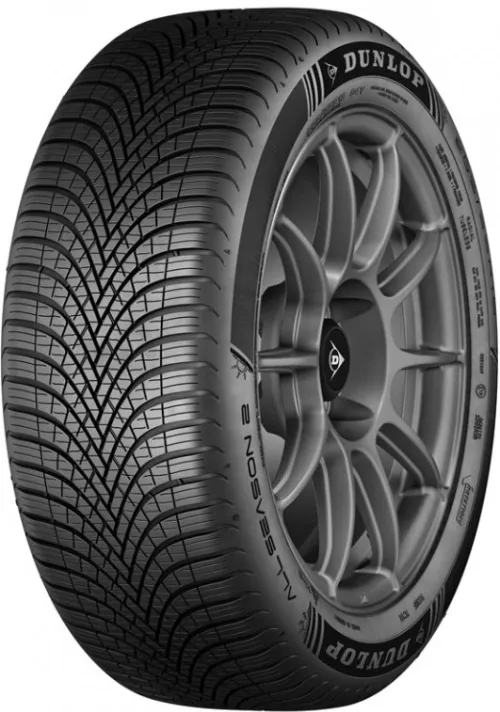
 Dunlop All Season 2Firestone Multiseason 2Dunlop All Season 2Firestone Multiseason 2Dunlop All Season 2Firestone Multiseason 2
Across the two measured braking tests, the Dunlop All Season 2 averages 42.1m dry stopping distance against the Firestone Multiseason 2's 41.7m — a near-identical result, with Firestone actually shading it by a fraction of a car length. Dig into the individual tests and the picture is mixed rather than one-sided: in Autobild's 2025 225/40 R18 test the Firestone stopped a full metre shorter (41.5m vs 42.5m), while in the 2024 225/50 R17 trial the Dunlop edged it back (41.6m vs 41.8m). In practice, from 100km/h, that's a difference of well under a car length either way — not something a driver will notice in daily use.
Where the two diverge more meaningfully is in handling character. Firestone's dry-handling-objective score of 96.5 is exceptional and points to genuinely composed steering response and body control on a dry road, something Tyre Reviews' testers echoed even while flagging "extended dry braking" as a weak point in isolation. Dunlop's dry-handling average, by comparison, sits lower at 75.3, and its dry-braking performance score of 57 is the weakest single metric in its entire scorecard — ADAC's 2026 test explicitly cited "dry and wet deficits" as the reason for a weak overall balance verdict.
The mechanism behind this is fairly straightforward tyre engineering: Dunlop's compound and construction are tuned hard for comfort, low rolling resistance and mileage — attributes that trade against ultimate dry bite. Firestone accepts a firmer, grippier compound to hold its snow and wet-handling promises, and that same stiffness pays off in dry precision even if it occasionally costs a metre or two under maximum braking. Neither tyre is a dry-weather specialist, but if sharp, confidence-inspiring dry handling matters more than outright braking numbers, the Firestone edges it.
Dunlop All Season 2Firestone Multiseason 2Dunlop All Season 2Firestone Multiseason 2Dunlop All Season 2Firestone Multiseason 2Dunlop All Season 2Firestone Multiseason 2Dunlop All Season 2Firestone Multiseason 2Dunlop All Season 2Firestone Multiseason 2Wet braking is where the picture flips decisively in Dunlop's favour. Across the two measured tests, the All Season 2 averages 53.3m compared with the Multiseason 2's 57.2m — nearly a 4-metre gap, or close to a full car length, and the trend is consistent rather than a one-off: Dunlop stopped shorter in both the 2025 test (49.2m vs 50.3m) and, far more dramatically, in the 2024 test (57.3m vs a lengthy 64.0m). That 6.7-metre swing in the second test is the kind of margin that decides whether you stop short of an obstacle or hit it.
This lines up with the broader wet dataset. Dunlop's wet performance score of 73.5 and aquaplaning score of 70 both comfortably beat Firestone's 67.7 and 56.2 respectively, and Autobild's 2025 test explicitly marked the All Season 2 down for weaknesses in aquaplaning and dry grip while still rating it competitive overall — implying its aquaplaning issue is relative, not absolute. Firestone's own test history is more consistently critical here: "mäßige Aquaplaningqualitäten" and "geringe Sicherheitsreserven bei Kurvenaquaplaning" turn up repeatedly across its 2020, 2022 and 2023 tests, alongside ADAC 2024 noting "leichte Schwächen auf nasser Fahrbahn."
Interestingly, the EU wet-grip label doesn't tell the same story — Firestone's Multiseason 2 rates mostly B-class (95% of listed sizes) against Dunlop's predominantly C-class rating (71%), a reminder that the standardised label measures straight-line wet grip in isolation and doesn't capture the cornering-under-water or braking-consistency issues that real-world testers keep flagging on the Firestone. Tyre Reviews did praise the Multiseason 2 as "very good around the wet handling lap," so it isn't a wet-weather liability across the board — but on the metric that matters most in an emergency, stopping distance, Dunlop is the more dependable choice.
Dunlop All Season 2Firestone Multiseason 2Dunlop All Season 2Firestone Multiseason 2Dunlop All Season 2Firestone Multiseason 2Dunlop All Season 2Firestone Multiseason 2Dunlop All Season 2Firestone Multiseason 2Snow is the Multiseason 2's reason for existing, and the test record backs that up more consistently than it does for the Dunlop. Firestone's snow credentials show up again and again across four separate test cycles: "excellent grip in all snow tests" from Tyre Reviews 2023, "stabiles Fahrverhalten auf Schnee" from Autobild 2023, "kurze Schnee- und Nassbremswege" from Autobild 2022, and "gute Traktion und kurze Bremswege auf Schnee" going back to Autobild 2020. Its detail scores back this narrative with a snow-traction average of 87 and snow-braking of 86.3, both ahead of Dunlop's 83 and 84.3 respectively.
Dunlop isn't far behind on the raw numbers — its overall snow performance score of 80.9 is actually marginally higher than Firestone's 79.9, and its snow detail average of 90.5 is the strongest single category in its entire dataset, with ADAC 2026 confirming it "can perform well on snow." But the qualitative feedback tells a slightly different story: AUTOBILD 2024 flagged "mäßige Seitenführung auf Schnee" (moderate lateral grip on snow) on the Dunlop, a criticism Firestone has also drawn in some tests (Autobild 2022's "mäßige Seitenführung auf Schnee" and 2023's understeer-prone snow handling), suggesting neither tyre is flawless in lateral snow grip even where straight-line traction is strong.
Net effect: both tyres are genuinely capable in snow rather than token all-season performers, but Firestone's snow ability is the more decorated and consistently praised across independent tests, while Dunlop's is a strong but slightly less battle-tested asset in an otherwise more comfort-and-efficiency-led package.
Dunlop All Season 2Firestone Multiseason 2Dunlop All Season 2Firestone Multiseason 2Dunlop All Season 2Firestone Multiseason 2On comfort and refinement, the Dunlop All Season 2 is comfortably the more polished tyre. Its comfort score of 79 and noise score of 86.2 both outpace the Firestone's 73.4 and 76.2, and this is reinforced by Autobild's characterisation of the Dunlop as a "Langlauf-Champion" with an "ausgewogen gutes Leistungsniveau ohne gravierende Schwächen" — a balanced, quietly capable tyre without serious flaws. Tyre Reviews, by contrast, noted "slightly below average comfort" on the Multiseason 2, consistent with a tyre whose firmer, snow-and-handling-focused construction trades away some of the cushioning a premium-segment buyer would expect.
Running costs are where Dunlop pulls furthest ahead. Its rolling-resistance score of 88.3 and mileage score of a perfect 100 translate directly into real savings — AUTOBILD 2024 specifically credited it with the "beste Kilometerlaufleistung im Test" (best mileage in the test) and top marks in the cost chapter, and its 94/100 average price-value-ratio across tests is one of the strongest figures in this entire comparison. Firestone's rolling resistance (78.6) and mileage (71) scores are respectable but clearly behind, and its EU fuel label mix — 80% C-class but with a concerning 15% falling to E-class — suggests inconsistency across sizes that the Dunlop's cleaner label profile (52% C, 46% B) doesn't share.
Real owners add useful colour here. The Firestone carries a strong 9.6/10 rating from 12 Heureka reviews, with buyers repeatedly citing it as a "reputable and reliable brand" with "good price/value ratio" — though the most common caveat is that it's "too early to evaluate long-term durability," a fair point given ADAC 2024 only rated its projected mileage and abrasion as "befriedigend" (satisfactory). The Dunlop, frustratingly, has essentially no owner review data yet, so its excellent lab-measured mileage and value scores remain unconfirmed by real-world drivers — worth bearing in mind if you weight owner experience heavily.
Dunlop All Season 2Firestone Multiseason 2Dunlop All Season 2Firestone Multiseason 2Dunlop All Season 2Firestone Multiseason 2Dunlop All Season 2Firestone Multiseason 2Add it all up and the Dunlop All Season 2 is the stronger all-round proposition: it won both mutual head-to-head tests, brakes noticeably shorter in the wet (by up to 6.7m in one test), rides quieter and more comfortably, and delivers class-leading mileage and value scores that should translate into real savings over the tyre's life. It's the tyre to choose if you cover high annual mileage, want a quiet and comfortable daily driver, and live somewhere winters are moderate rather than severe — its snow ability is solid, just not its headline strength.
The Firestone Multiseason 2 earns its place for a narrower but real reason: snow traction and braking that repeated independent tests rate more consistently highly than the Dunlop's, plus genuinely sharp dry-handling precision, all at a lower price point that owners themselves praise. It's the more sensible pick for drivers in regions with reliably harsh winters who want confident snow grip without stepping up to a dedicated winter tyre, and who are willing to accept a firmer ride, more road noise, and a real wet-braking deficit in exchange.
The honest trade-off: buy the Dunlop for a more rounded, efficient, comfortable tyre with a clear wet-weather safety edge; buy the Firestone if snow performance and upfront price are your priorities and you can live with weaker wet braking and reduced refinement. Given the two tyres' head-to-head record and the size of the wet-braking gap, the Dunlop is the safer default recommendation for most mixed-climate drivers — but the Firestone is not a bad tyre, just a more specialised one.
Compare prices across all available dimensions for these tyres.
 VS
VS
 VSVSVS
 VSVS
VSVS VSVS
VSVS VSVSDunlop All Season 2 vs GoodYear Vector 4Seasons Gen-3Dunlop All Season 2 vs Pirelli Cinturato All Season SF2Dunlop All Season 2 vs Hankook Kinergy 4S2 H750Dunlop All Season 2 vs Continental AllSeasonContact 2Firestone Multiseason 2 vs Michelin CrossClimate 2
 Firestone Multiseason 2 vs Falken EuroALL Season AS210
 Firestone Multiseason 2 vs Kumho HA32 Solus 4SFirestone Multiseason 2 vs Goodyear Vector 4Seasons Gen-3