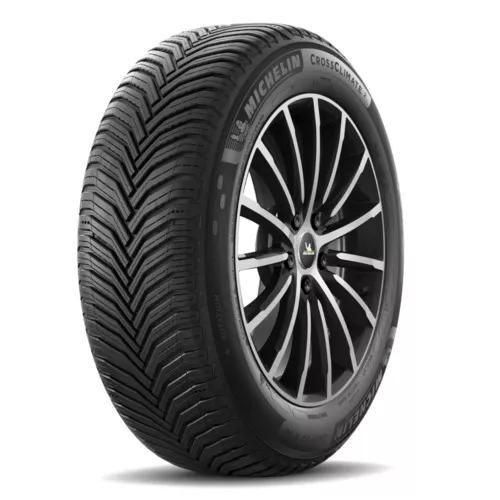
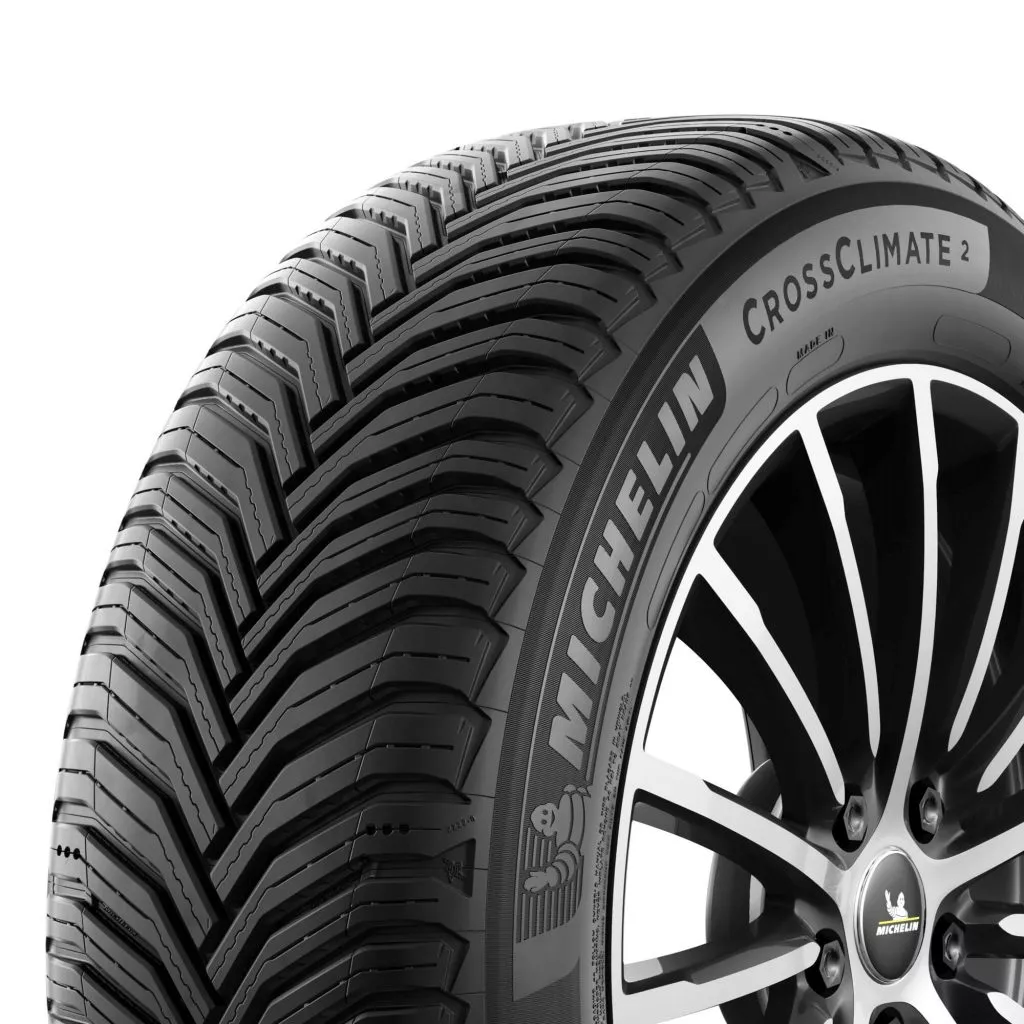
The Michelin CrossClimate 2 is the tyre that turned \"all-season\" from a compromise into a genuine category leader. Built in Italy and Spain, it's the second generation of Michelin's category-defining Michelin CrossClimate, and it sits firmly in the premium segment — a tyre engineered for drivers who want one set of rubber to handle everything from a dry motorway blast to a genuine snowstorm without ever feeling like a jack-of-all-trades. The Viking Fourtech, by contrast, is a budget all-rounder with no listed predecessor, no country of manufacture disclosed, and a segment positioning that's explicitly lowcost. It exists for buyers who want basic all-weather coverage at the lowest possible price, full stop.
The gulf between them shows up before you even look at a single braking figure. Michelin covers 94 dimensions from R15 to R21, reaching into large-wheel SUV and premium saloon territory; Viking covers just 29 dimensions from R13 to R19, aimed squarely at smaller, older, or budget-focused vehicles. Michelin carries an EU wet grip rating of B across the board; Viking doesn't even have EU label data published in this dataset, which itself tells you something about how each brand expects to be shopped.
The single biggest character difference is that the CrossClimate 2 was engineered to eliminate the all-season tyre's traditional weak points — Michelin's own literature promises \"higher safety levels in all seasons\" via a Thermal Adaptive Tread Compound, and the independent test record largely backs that up, with testers repeatedly calling it a genuine winter specialist that also handles dry roads with precision. The Fourtech makes no such promises; it's a tyre built to a price, and our own overall rating of 92/100 for the Michelin against 0/100 for the Viking (effectively unrated in our system) reflects how differently these two tyres are positioned, even before you get into the specifics.
", "dry": "Across the one mutual dry-braking test available — Autobild's 2021 225/50 R17 braking-specific group test — the CrossClimate 2 stopped in 37.6m against the Fourtech's 43.5m, a gap of 5.9m. That's more than a full car length of extra distance the Viking needs to come to a halt from the same test speed, and it's no fluke: Michelin actually topped that entire 32-tyre field for dry braking, finishing 1st, while the Fourtech placed a distant 13th. The wider performance-score picture confirms this isn't a one-off — Michelin's dry score of 87.2 and dry-braking score of 91.6 dwarf the Fourtech's 59 and 47 respectively, one of the largest gaps in this entire comparison.
The reason goes beyond compound choice. Michelin's detail scores show an objective dry-handling figure of 96.3 and a measured dry-handling score of 91.5 — numbers that place the CrossClimate 2 among the most precise all-season tyres tested, and German testers have repeatedly praised its \"sichere und präzise Eigenschaften im Grenzbereich auf trockener Fahrbahn\" (safe and precise behaviour at the limit on dry roads). Owner reviews back this up too: multiple CrossClimate 2 drivers specifically cite \"great dry grip and precise track holding\" as a reason they'd buy again, a genuinely unusual compliment for a tyre that also has to double as a snow tyre.
The Fourtech simply wasn't built for this kind of test. With a dry-braking score of just 47 — the weakest figure in its entire scorecard — and real owner feedback describing dry braking as \"longer\" and summer handling as \"almost like you drive on winter tyre,\" the Viking's dry-weather compromise is the clearest, most consistently reported weakness across every source in this comparison. It's not that the Fourtech is unsafe in isolation, but next to the CrossClimate 2 it gives up serious stopping distance and precision the moment the road is dry and demanding.
", "wet": "In the same mutual test, the wet-braking numbers flip slightly in the Fourtech's favour: 52.6m against the CrossClimate 2's 53.9m, a narrow 1.3m gap. This is genuinely one of the few areas where the budget tyre holds its own, and it lines up with the wider wet performance scores too — Michelin's wet score of 71.8 is actually lower than the Fourtech's 70.2 by only a whisker, and testers have consistently flagged wet braking as the CrossClimate 2's one real soft spot, with Tyre Reviews specifically noting \"long wet braking\" and Autobild repeatedly logging \"leicht verlängerte Bremswege auf nasser Fahrbahn\" (slightly extended braking distances on wet roads) across multiple test years.
That said, the picture isn't simply that the Fourtech is the better wet-weather tyre. Michelin's aquaplaning score of 76.7 sits behind the Fourtech's surprisingly strong 86.5, yet Michelin's own detail scores show a wet-handling-objective figure of 92.5, and owner reviews consistently praise "excellent wet grip and stability" as one of the CrossClimate 2's most-mentioned strengths — a reminder that raw braking distance and cornering confidence are different things. One long-term Kia Sorento owner described "good grip in the wet, and way way better than any US all-season tyre," which suggests the CrossClimate 2's wet-weather understeer tendency (flagged in its key weaknesses) is a limit-handling trait rather than something drivers notice in everyday conditions.
The Fourtech's wet performance is a genuinely pleasant surprise for a lowcost tyre — one owner specifically noted it "handles good" in the wet despite reservations elsewhere, though another flagged noise "in heavy rain" as a downside. But with no EU wet grip label published and only a handful of independent tests to draw on, buyers are taking more on faith with the Viking than with the CrossClimate 2, whose B-rated wet grip label across all 94 sizes gives a documented baseline the Fourtech simply doesn't offer.
", "snow": "Snow is where this comparison stops being close. The CrossClimate 2 posts a snow score of 92.3 against the Fourtech's 70.7 — a 21.6-point gap that's the largest single difference in this entire dataset — and the detail scores go even further: an objective snow-handling score of 98.5 and a measured snow-handling score of 95 place the Michelin among the best snow performers tested, all without giving up its all-season identity. Autobild's testers have said outright that the CrossClimate 2 "schneidet als bester Kandidat im Schnee besser ab als der mitgetestete Winterreifen" — it beat an actual dedicated winter tyre in the same test. That's an extraordinary claim for an all-season product, and it's been repeated across multiple test years, not just a single fluke result.
Owner testimony reinforces this from the real world rather than the test track: a Ford Focus driver switching from generic all-seasons described the CrossClimate 2 as "night and day," saying it handled slush and snow with ease "especially from starting on tricky hills," while a Kia Sorento owner who drove a full Salt Lake City winter on them called them "exceptional" and said they "couldn't get stuck even in deep snow." Both tyres carry the 3PMSF severe-weather symbol, so neither is a fair-weather pretender, but the Michelin's winter performance is genuinely closer to a dedicated winter tyre than to a typical all-season compromise.
The Fourtech's snow score of 70.7 is respectable for a budget tyre and multiple owners were pleasantly surprised by it — one described being "surprised me with the grip" on snow, another said snow performance "handled much better than expected." That's a real point in the Viking's favour for cost-conscious buyers in mild-winter regions. But set against the CrossClimate 2's near-winter-tyre snow credentials, the Fourtech is playing an entirely different game — adequate for occasional snow, not a tyre you'd trust through a serious winter the way you might the Michelin.
", "comfort": "Comfort scores put Michelin at 73 and the Fourtech at a slightly higher 76, with noise scores of 69.4 versus 76 — on paper a win for the budget tyre. But owner reviews for the CrossClimate 2 tell a more nuanced story: "low cabin noise / quiet ride" is actually the single most-mentioned positive in Michelin's customer feedback, cited twelve times, alongside "high ride comfort and shock absorption" cited six times. One Volvo XC40 owner did note "perhaps a slightly firmer ride," which may explain why the raw comfort score sits a few points below the Fourtech's — the CrossClimate 2 trades a touch of plushness for the structural rigidity that underpins its dry and snow precision.
Running costs are where the Michelin's premium positioning is genuinely justified rather than just marketing. Its rolling-resistance score of 87.2 and EU fuel label — 47% C-class, 30% B-class, and a notable 17% reaching A-class — translate into real fuel savings, and Autobild has repeatedly praised its "niedriger Rollwiderstand und entsprechendem Spritsparpotenzial" (low rolling resistance and corresponding fuel-saving potential) across several test years. ADAC's 2024 test specifically flagged the CrossClimate 2 for its "geringster Abrieb im Test" — the lowest wear of any tyre tested — and its mileage score of 77.4 backs that up. The Fourtech actually posts an even higher rolling-resistance score of 96, and its mileage score of 65 is solid for its class, but with no published EU label and only a 54/100 average owner rating across five reviews, its running-cost profile is far less documented.
Price is the crux of the value argument. Michelin's own listed weakness is a high per-kilometre cost given only average tread life relative to its premium purchase price — Tyre Reviews specifically called this out, and Autobild's 2023 test flagged "Hoher Preis" as a genuine downside. Yet a 9.7/10 rating across 66 Heureka reviews and an 89/100 average across 96 Tyre Reviews entries suggest owners feel the performance justifies the outlay. The Fourtech is unambiguously the cheaper tyre to buy, and one owner specifically praised it as "very good tyre for the price," but a 54/100 average rating and reports of pressure loss and sidewall bumps after modest mileage suggest the savings come with real durability trade-offs.
", "verdict": "This isn't a close contest on raw capability — the CrossClimate 2 has won both of the two mutual head-to-head tests on record, topped the field outright in dry braking, and posts dramatically stronger scores in dry, snow, and overall reliability. It's also priced and positioned like the category leader it is, with a 92/100 rating, near-universal critical acclaim, and owner satisfaction scores that are hard to argue with. If you drive year-round in a climate that brings real snow, want a tyre that can legitimately substitute for winter rubber, and value long-term running economy over sticker price, the Michelin CrossClimate 2 is the clear, well-earned recommendation.
The Viking Fourtech isn't a bad tyre so much as a differently-aimed one. Its wet braking and aquaplaning figures are genuinely competitive, and several owners were pleasantly surprised by its snow performance given its budget positioning. For a driver with an older, lower-value car, modest annual mileage, and a genuinely tight budget who mostly wants basic all-weather coverage without a harsh dry-weather penalty being the top priority, the Fourtech is a defensible low-cost choice — just go in accepting that dry braking and outright precision are its clear weak points.
But for anyone cross-shopping the two on merit rather than price alone, this isn't really a fair fight: the CrossClimate 2 out-brakes, out-grips, and out-lasts the Fourtech in nearly every measurable way, and the data suggests Michelin's premium price is backed by genuine engineering rather than brand markup. Spend the extra money if you can; the Fourtech makes sense only when the budget genuinely won't stretch to the Michelin.
", "claim": "Michelin's all-season benchmark dominates on snow, dry grip and value; Viking's budget tyre only competes on price.", "good_for": { "Michelin CrossClimate 2": ["Drivers in genuinely snowy climates", "Those wanting near-winter-tyre security", "Premium SUV and saloon owners", "Buyers valuing long-term fuel savings"], "Viking Fourtech": ["Tight-budget everyday drivers", "Older or lower-value vehicles", "Mild-winter, low-mileage use", "Buyers prioritising upfront price"] }, "not_for": { "Michelin CrossClimate 2": ["Buyers unwilling to pay a premium", "Those chasing the shortest wet braking"], "Viking Fourtech": ["Spirited or high-speed dry driving", "Drivers facing serious winter conditions", "Those wanting documented EU label data"] } }

Michelin CrossClimate 2
Viking Fourtech
Michelin CrossClimate 2
Viking Fourtech
Michelin CrossClimate 2
Viking Fourtech
Michelin CrossClimate 2
Viking Fourtech
Michelin CrossClimate 2
Viking Fourtech
Michelin CrossClimate 2
Viking Fourtech
Michelin CrossClimate 2
Viking Fourtech
Michelin CrossClimate 2
Viking Fourtech
Michelin CrossClimate 2
Viking Fourtech
Michelin CrossClimate 2
Viking Fourtech
Michelin CrossClimate 2
Viking Fourtech
Michelin CrossClimate 2
Viking Fourtech
Michelin CrossClimate 2
Viking Fourtech
Michelin CrossClimate 2
Viking Fourtech
Michelin CrossClimate 2
Viking Fourtech| Organization | Season | Year | Dimension | |
|---|---|---|---|---|
Autobild | All season | 2021 | 225/50 R17 | View |
Compare prices across all available dimensions for these tyres.
VS
VS
VS
VS
VS
VS
VS
VS
VS
VS
Michelin CrossClimate 2 vs Bridgestone Weather Control A005 EVO
Michelin CrossClimate 2 vs Continental AllSeasonContact
Michelin CrossClimate 2 vs Vredestein Quatrac Pro
Michelin CrossClimate 2 vs Goodyear Vector 4Seasons Gen-3
Viking Fourtech vs Giti AllSeason AS1
Viking Fourtech vs Nexen N Blue 4 Season
Viking Fourtech vs Maxxis Premitra AS AP3
Viking Fourtech vs Goodyear Vector 4Seasons Gen-3