
AUTO BILD’s annual summer tyre mega-test for 2026 put 50 tyres through a gruelling braking qualification before selecting the top 20 for the full test program. Tested on a BMW 5 Series (G60) in size 245/45 R19 102Y, the finalists were evaluated across three weighted categories: Wet (40%), Dry (40%), and Cost (20%). Testing took place at the ATP proving ground in Papenburg (braking) and the Idiada circuit in Alcarràs, Catalonia (handling, aquaplaning, comfort).
The result: a convincing new test winner from Hankook, a surprising budget brand in the top 5, and some established premium names finishing lower than expected.
☰
Top 3 comparison
Test winner: Hankook Ventus Evo (★99) (Grade 1.1 — Exemplary)
The Hankook Ventus Evo (★99) dominates this test with a near-perfect overall grade of 1.1. It recorded the shortest dry braking distance of all 20 finalists at just 32.8 m from 100 km/h and the fastest wet handling speed at 83.6 km/h on the Idiada circuit. In the dry, it was equally untouchable with a handling speed of 101.5 km/h — the fastest in the field. At a set price of around €620, it also offers the best price-per-kilometre ratio at just €11.01/1,000 km. The only area where it doesn’t lead is aquaplaning protection, where its 90.4 km/h places it in the lower half.
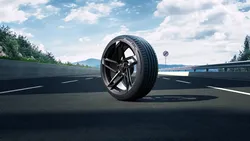
Hankook Ventus Evo
Dimensions: 205/25R17 - 345/55R22
Number of sizes: 122
Number of tests: 5
Runner-up: Goodyear Eagle F1 Asymmetric 6 (★94) (Grade 1.2 — Exemplary)
The Goodyear Eagle F1 Asymmetric 6 (★94) earns the “Eco Master” distinction with a predicted mileage of 63,830 km — nearly 4,000 km more than the next best. It also wins AUTO BILD’s separate “Green Tyre” environmental rating with a grade of 1-. Despite this endurance focus, it delivers strong all-round performance in both wet and dry handling. At €780 for a set, the price-per-kilometre works out to a competitive €12.22/1,000 km. Its aquaplaning resistance is excellent at 94.7 km/h (2nd best).
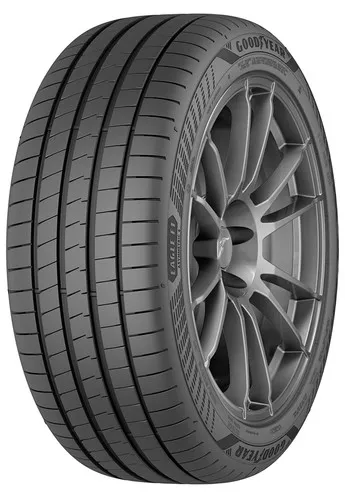
Goodyear Eagle F1 Asymmetric 6
Dimensions: 205/25R17 - 325/65R23
Number of sizes: 180
Number of tests: 5
Third place: Michelin Pilot Sport 5 (★94) (Grade 1.3 — Exemplary)
Michelin Pilot Sport 5 (★94) rounds out the podium with exceptional dry handling (101.3 km/h — second fastest) and strong mileage at 59,670 km. Its wet handling at 82.7 km/h and short braking distances keep it competitive across all safety-critical disciplines. The trade-off comes in a slightly elevated pass-by noise and a premium price of €920 for four tyres, making it the second most expensive option. Still, for drivers who value a balance of high performance and longevity, the Michelin delivers.
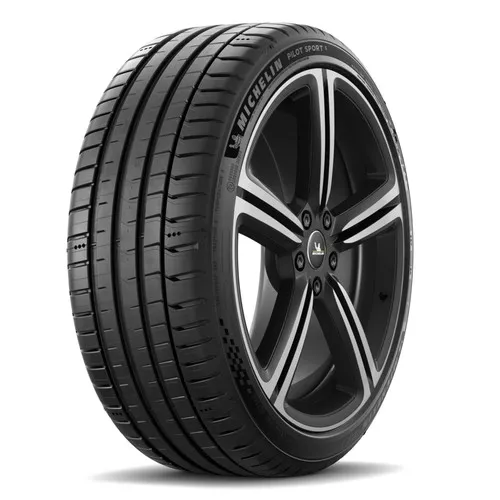
Michelin Pilot Sport 5
Dimensions: 0/0R0 - 315/55R22
Number of sizes: 66
Number of tests: 5
The budget surprise: Giti GitiSport S2+ (★89) (Grade 1.4 — Exemplary)
Perhaps the biggest story of this test is Giti GitiSport S2+ (★89) finishing in 4th place with an “Exemplary” verdict — tied with Pirelli. At just €610 for a set of four, it’s one of the cheapest tyres in the test yet delivers performance that rivals premium brands. Its aquaplaning resistance of 94.5 km/h is third-best overall, and braking distances in both wet (42.5 m) and dry (34.3 m) are solidly mid-pack. This is a genuine price-performance revelation.
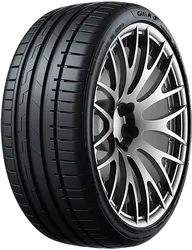
Giti GitiSport S2+
Dimensions: 225/40R17 - 255/45R20
Number of sizes: 13
Number of tests: 3
Premium doesn’t always mean best
Continental PremiumContact 7 (★98), the most expensive tyre in the test at €980 for a set, finishes in 6th place with a grade of 1.6. While its wet and dry handling are respectable, it doesn’t justify the €370 premium over the test-winning Hankook. Similarly, Bridgestone Potenza Sport (★87) EVO at €850 lands in 11th place, and Nokian Powerproof 2 (★84) at €760 ties for 11th — both solid but unremarkable for their price tier.
Wet braking: the safety story
The most dramatic safety finding is in wet braking from 100 km/h. The Linglong Sport Master (★77) recorded the shortest distance at a remarkable 39.3 m, beating every premium tyre by nearly 3 metres. At the other end, Yokohama Advan Sport V107 (★67) needed 47.9 m — a gap of 8.6 metres, equivalent to roughly two car lengths at motorway speed. This spread underscores why braking performance should be a primary factor when choosing summer tyres.
Dry handling: tight at the top
On the dry handling circuit, the differences were remarkably small. Just 3 km/h separated the fastest (Hankook at 101.5 km/h) from the slowest (Falken at 98.5 km/h) among the 20 finalists. This confirms that modern summer tyres, even from budget brands, deliver competitive dry grip. The real differentiator between premium and budget shows up in wet conditions and long-term cost.
Cost chapter: mileage and value
The cost analysis reveals stark differences in tyre longevity. Goodyear’s predicted 63,830 km is nearly double the Linglong’s 35,570 km. This means the Linglong, despite its low purchase price of €450, actually costs more per kilometre in the long run. Two tyres — Linglong Sport Master (★77) and Toyo Proxes Sport 2 (★71) — received a downgrade in the cost chapter due to poor mileage, pushing them to “Satisfactory” verdicts despite decent driving performance.
The bottom of the field
Kleber Dynaxer HP5 (★64) (19th, grade 3.2) and Sava Intensa UHP 2 (★65) (19th, grade 3.2) share the bottom positions. Both show compromised wet grip with handling grades of 3- — indicating noticeably imprecise behaviour in the wet. The Kleber partially compensates with the lowest rolling resistance in the entire test (grade 1+), making it the most fuel-efficient option. The Sava offers a low purchase price of €570 but limited overall performance.
Bottom line
The Hankook Ventus Evo stops shorter and corners faster than tyres costing 50% more — at €620 for a set, it offers the best value in the test. Giti finishing 4th at €610 is a notable result for a brand not usually associated with top-tier performance. Continental’s PremiumContact 7, the most expensive tyre at €980, landed in 6th — solid, but hard to justify the premium. The 8.6 m gap in wet braking between the best and worst finishers is a reminder that tyre choice has real safety consequences. For drivers prioritising longevity, the Goodyear’s predicted 64,000 km mileage stands out, and it performs well across the board.