
Winter tyre tread depth does not create one simple safety cliff. In 2026, ADAC reported a study that tested five 185/65 R15 winter tyres and compared about 8 mm of new tread with 4 mm and 2 mm. At 4 mm, the average wet-braking result was essentially unchanged, but water clearance, wet handling and snow performance had already deteriorated. At 2 mm, the losses were broader, with average cornering-aquaplaning resistance 52.2% lower than the new-tyre reference.
For a driver, 4 mm is therefore a useful replacement-planning point under ADAC's safety recommendation. This technical guide does not provide a legal minimum: check the current official requirements wherever the car is driven. Measure each tyre in the relevant tread grooves, plan ahead as it approaches 5 mm, and act on ADAC's 4 mm replacement recommendation. This guide explains all eight disciplines, separates the two published measures of wet handling, shows the available model-level comparison, and turns a tread measurement into a practical replacement decision.
☰
What the 2026 worn-winter-tyre test examined
ADAC published its primary test report on 8 September 2026, while ACL identifies the work as a joint European motoring-club study. ADAC's official press release confirms that the comparison tyres were mechanically reduced to 4 mm and 2 mm before the wet-road and snow tests.
Five winter models in size 185/65 R15 were examined: Bridgestone Blizzak LM 005, Kumho WinterCraft WP52+, Linglong Sport Master Winter, Michelin Alpin 7 and Vredestein Wintrac (★67). Their new tread was about 8 mm. The controlled comparison therefore addressed a focused question: how did this selection behave when tread depth changed from roughly new to 4 mm and then 2 mm?
The study was intended to identify general wear trends. Drivers choosing replacements should therefore compare current winter tyres using broader current test evidence.
Winter tyre tread depth at 4 mm and 2 mm: all disciplines
The following table covers all eight published disciplines. It has nine result rows because wet-handling lap time and wet-handling assessment are two measures of the same discipline. A percentage, distance, lap-time change, score and qualitative assessment are not interchangeable. A reference result means that the new-tyre average is the comparison baseline where the sources did not provide an absolute value.
How performance changed from new tread to 4 mm and 2 mm
| Discipline | New | At 4 mm | At 2 mm | Practical reading |
|---|---|---|---|---|
| Straight-line aquaplaning resistance | Reference result | 12.4% lower | 22.5% lower | Water-clearing reserve was already reduced at 4 mm and fell further at 2 mm. |
| Cornering-aquaplaning resistance | Reference result | 24.7% lower | 52.2% lower | The largest reported average loss concerned turning through standing water. |
| Wet braking distance | 31.9 m | 31.4 m | 37.3 m | Essentially unchanged at 4 mm. At 2 mm, the rounded averages differ by about 5.4 m. |
| Wet handling, lap time (measure 1 of 2) | Reference lap time | 1.8% longer | 5.4% longer | Combined wet-road performance was already weaker at 4 mm and deteriorated further at 2 mm. |
| Wet handling, assessment score (measure 2 of 2) | 2.4 | 3.4 | 4.7 | Lower is better. The assessment worsened at both worn depths. |
| Wet lateral grip without aquaplaning | Reference result | Slight loss | About 4% lower | Ordinary wet lateral grip changed much less than aquaplaning resistance. |
| Snow traction | Reference result | 8.8% lower | 15.9% lower | The ability to generate drive force on snow declined progressively. |
| Snow braking | Reference result | ADAC-reported deterioration: 12.4% | Braking distance from 30 km/h: 20.5% longer | ADAC does not specify the 4 mm measurement basis as precisely as it does for the 2 mm result. |
| Snow handling | Reference assessment | Significantly worse; mean score 5.38 | Strongly worsened; mean score 7.17 | Lower is better. ADAC extended its normal assessment scale for these results. |
Sources: ADAC originating test report and Automobile Club du Luxembourg detailed results. Checked 10 September 2026. Aquaplaning, wet-handling, wet-grip and snow-traction percentages are aggregate changes relative to the new-tyre results. For snow braking, ADAC reports 12.4% deterioration at 4 mm without defining the basis as precisely as the 2 mm prose, which states that braking distance from 30 km/h increased by 20.5%.
ADAC's overview rounds the aquaplaning figures to whole percentages, while ACL supplies the one-decimal figures used here.
The pattern matters more than any isolated cell. At 4 mm, resistance to aquaplaning, combined wet handling and all three snow disciplines had deteriorated. At 2 mm, deterioration was broader and generally more pronounced.
The snow-handling row needs special care. In an English paraphrase of ADAC, the 4 mm result was significantly worse and the 2 mm result was strongly worsened. ACL adds mean scores of 5.38 and 7.17, respectively. Those scores use a lower-is-better assessment in which the scale was extended to preserve distinctions beyond its usual range. They are not percentages and should not be compared numerically with traction or braking changes.
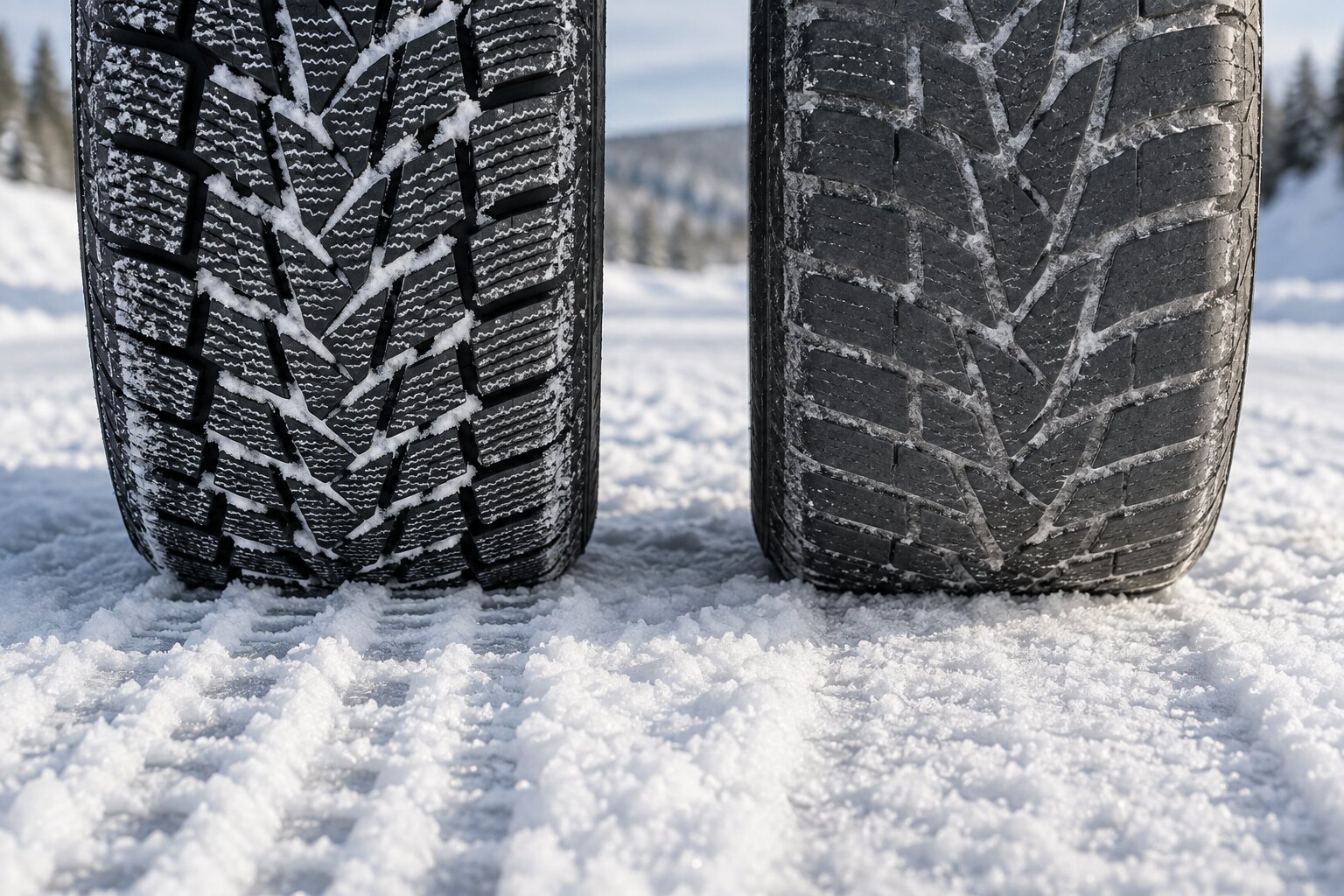
Why aquaplaning reserve can decline before wet braking
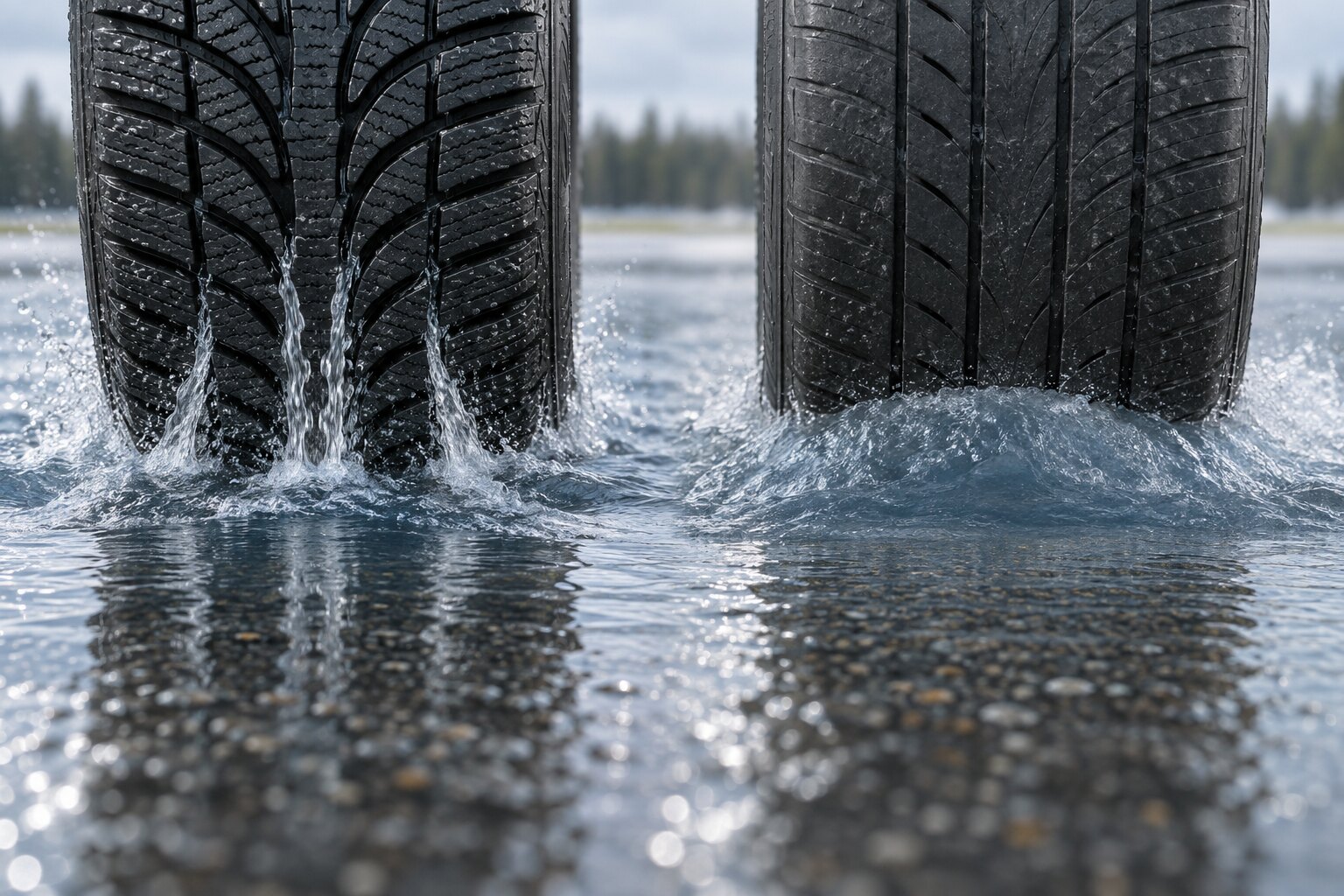
Wet performance is not one property. ADAC explains that shallower grooves have less volume available to take in and displace water. When the tread cannot clear the water quickly enough, a wedge forms beneath the tyre and the contact needed to transmit forces to the road is lost. The aquaplaning disciplines directly challenge that water-clearing capacity, including while the tyre is turning.
A wet-braking run, by contrast, measures longitudinal stopping on the test surface, while wet handling combines braking, steering, acceleration and transitions over a lap. The stable average braking distance at 4 mm therefore does not cancel the aquaplaning result. At that depth, the study had already measured weaker water clearance and combined handling. Reducing the tread to 2 mm also worsened the braking result.
The figures describe the controlled test conditions rather than an exact threshold for a particular journey. Their practical value is showing that water-clearance reserve can diminish before a driver sees a large change in an ordinary wet-braking figure.
ÖAMTC, one of the partner clubs, similarly interprets the principal deterioration as a wet-road and aquaplaning concern. That is relevant to drivers whose winters are frequently cold and wet even when snow is occasional.
What the model-level aquaplaning figures show
ACL disclosed cornering-aquaplaning losses for every tested model at 4 mm and 2 mm. Each percentage compares a tyre with its own result when new. The figures are not absolute aquaplaning speeds, and they do not reveal which model had the best starting point.
| Tyre | Loss at 4 mm versus its new result | Loss at 2 mm versus its new result |
|---|---|---|
| Bridgestone Blizzak LM 005 | 22.6% | 38.3% |
| Michelin Alpin 7 | 23.2% | 61.2% |
| Vredestein Wintrac (★67) | 28.9% | 56.2% |
| Kumho WinterCraft WP52+ | 25.2% | 54.0% |
| Linglong Sport Master Winter | 23.8% | 51.5% |
Source: Automobile Club du Luxembourg model results. Checked 10 September 2026.
The spread shows that tread reduction affected the five designs differently. Each percentage is a change from that tyre's own new result, so the smallest loss does not reveal the best absolute aquaplaning threshold. The sources also withhold a full per-model matrix for braking, snow behaviour and the other disciplines. These figures are consequently a wear comparison, not an overall ranking.
The Michelin result illustrates why its smaller loss at 4 mm cannot be projected linearly to 2 mm. Readers considering the named products can consult Tirelab's wider evidence for the Bridgestone Blizzak LM 005 and Michelin Alpin 7.
What 4 mm should mean for replacement planning
As advice published on 8 September 2026, ADAC recommends replacing winter tyres at 4 mm for safety reasons. This is a planning threshold supported by observed deterioration, not a claim that a tyre changes instantly from safe to unsafe at exactly 4.0 mm.
A practical decision process begins before the reading reaches exactly 4.0 mm:
- Around 5 mm: This depth was not tested, so do not interpolate a performance percentage. Measure and record it, estimate whether normal seasonal wear is likely to reach 4 mm, and arrange replacement early if it may.
- Around 4 mm: Treat replacement as due under ADAC's dated recommendation, especially if regular journeys include standing water or snow. Do not let one broadly stable braking measure outweigh deterioration in the other disciplines.
- Below 4 mm: Plan replacement rather than using 2 mm as a consumption target. The controlled comparison shows that aquaplaning and handling deteriorated even while the average 4 mm wet-braking result remained essentially unchanged.
- At 2 mm: Treat the tyre as past the target for further winter service and replace it before driving again in winter conditions.
The test covered five mechanically reduced tyres in one size. The controlled preparation helps compare tread depths, but it does not reproduce every feature of natural road wear. As an inference from that design, ageing, heat cycles, damage and uneven wear remain outside the depth-only comparison. Apply the results as a general trend across several disciplines rather than an exact margin for another tyre or vehicle.
How to check tread depth using the cited guidance
ADAC's current tread-depth guide says to use the indicator positions around the circumference and measure in a relevant main groove beside an indicator. Michelin separately advises checking several points across both the width and circumference. A coin can provide a rough check, but a tread-depth gauge gives the numerical reading needed near a replacement decision.
- Park safely and make the tread accessible.
- Place the tread-depth gauge in a relevant main groove, beside rather than on top of a wear indicator.
- Repeat the reading around the circumference and across the main tread area of each tyre.
- For a conservative record in this article, note the lowest relevant reading for that tyre. If the measurements reveal clear uneven wear or appear unreliable, have a tyre professional inspect the tyre and its wear pattern.
Write that conservative monitoring value against front left, front right, rear left and rear right, and add the date so the next inspection becomes a practical dated wheel-position record.